








17.02.2026
IoT Retrofit for Warehouses: How Businesses in Werl Digitize Logistics with LoRaWAN
Warehouses in the KonWerl business park, in Werl's town center or along the B1 highway - many logistics companies in Werl face the same challenge:...
LoRaWAN is the radio protocol for IoT: battery-powered sensors with ranges up to 15 km, no SIM cards, no monthly per-device costs. We plan your network, install gateways on-site and configure ChirpStack as an open-source network server – on your own infrastructure.
Sensor data flows via MQTT into ThingsBoard or Grafana – in real time, encrypted, on European infrastructure. No The Things Network, no cloud dependency. Your own network, your own data. From 5 sensors in a pilot project to 5,000 data points in a full rollout.
From the first gateway to a fully operational sensor network with real-time dashboards. Network planning, installation and configuration – let's discuss your project.
Site analysis, range calculation and gateway positioning. Indoor and outdoor, from campus coverage to multi-square-kilometre area deployments. We design for redundancy and scalability from day one.
Milesight, Kerlink, Dragino – we install and configure your gateways. PoE, solar or LTE fallback. Weatherproof for roof and mast mounting, wired or self-sufficient.
Open-source LoRaWAN server on your own infrastructure: device onboarding, payload decoders, multi-tenant capability. Self-hosted, no vendor lock-in, no TTN.
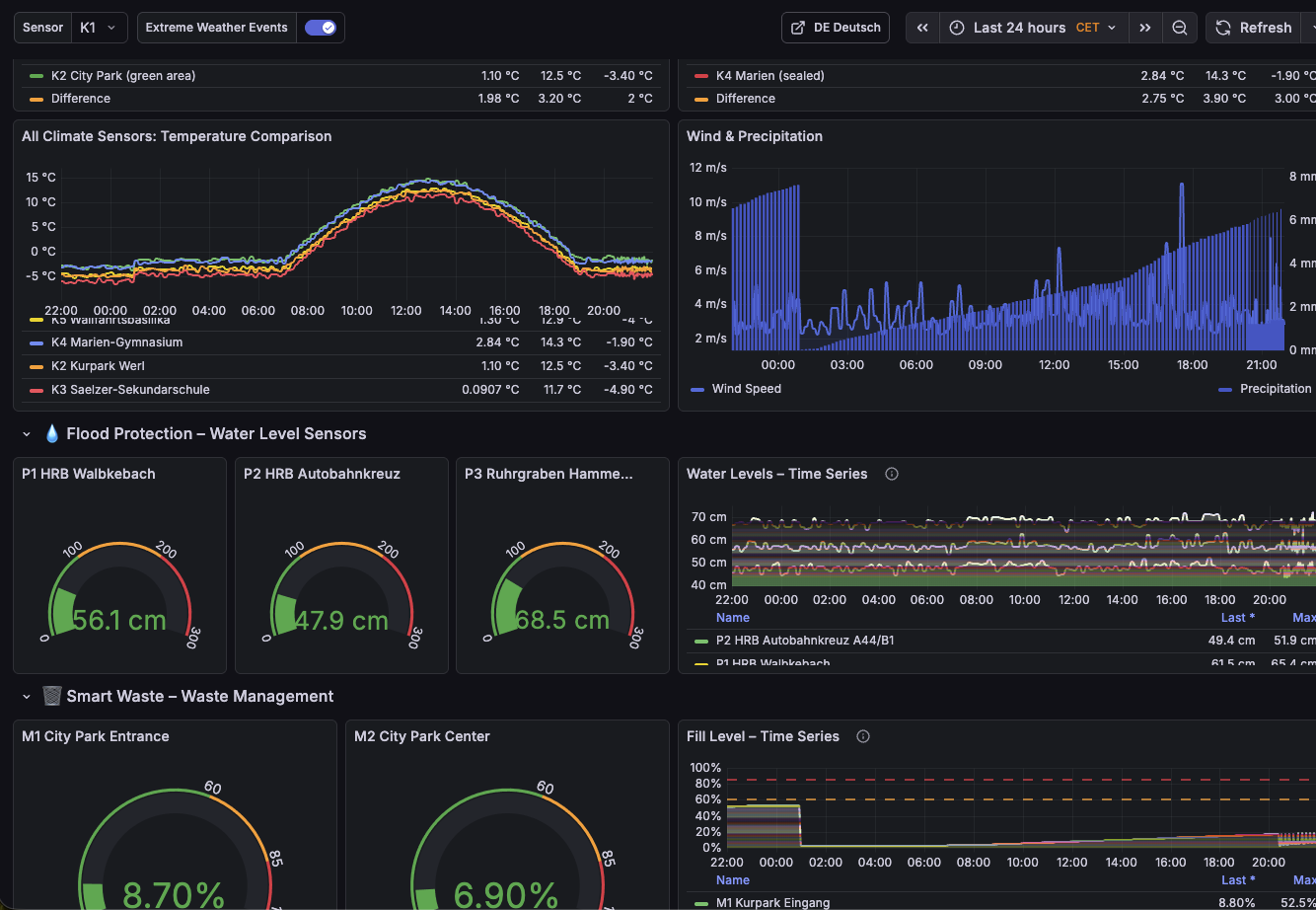
Temperature, humidity, vibration, water level, air quality, door contacts, power meters – we know the sensors, their payload formats and the matching decoders for ChirpStack.
Visualise sensor data in ThingsBoard or Grafana. Alerting on threshold breaches, automated reporting and role-based views. InfluxDB or TimescaleDB as the time-series backend.
Monitoring, updates and backups via merkaio. SLA-based support, proactive maintenance. You use the network and the data – we operate the infrastructure behind the scenes.
Proven open-source technologies for professional LoRaWAN networks

Open-source LoRaWAN network server. Device management, payload decoders, multi-tenant. Self-hosted on your own infrastructure.

Industrial-grade LoRaWAN gateways and sensors. UG65/UG67 gateways, IP67-rated sensors for indoor and outdoor use.
Radio protocol for battery-powered sensors. Ranges up to 15 km, years of battery life, no SIM costs.
Lightweight publish-subscribe protocol. ChirpStack forwards sensor data via MQTT to backend systems.

IoT platform for device management, rule engine and dashboards. Receives sensor data from ChirpStack and visualises it in real time.
Monitoring dashboards and alerting. Time-series visualisation for sensor data from InfluxDB or TimescaleDB.
Low-code automation for data flows. Payload transformation, routing and integration into existing IT systems.
Time-series database for high-frequency sensor data. Optimised for write throughput and fast queries.
From the factory floor to the field – LoRaWAN covers it all
Condition monitoring, vibration sensors, energy metering. Retrofit for existing equipment without PLC intervention – LoRaWAN sensors complement existing infrastructure without cabling.
Room climate, occupancy, door contacts, energy meters. LoRaWAN penetrates concrete and reinforced concrete – ideal for existing buildings without network cabling.
Water levels, water quality, overflow detectors. Battery-powered for years, ideal for distributed infrastructure along rivers, wastewater plants and wells.
Soil moisture, weather stations, irrigation control. LoRaWAN covers thousands of hectares with just a few gateways – battery-powered, low maintenance.
Street lighting, parking management, environmental monitoring, fill-level sensors. Scalable for municipal infrastructure with hundreds of measurement points.
Asset tracking, temperature monitoring in cold chains, fill-level measurement in silos. Indoor LoRaWAN for warehouses and logistics centres.
From the first gateway to a production-ready sensor network
What measurements do you need? What area, indoor or outdoor? We define sensor types, gateway positions and the appropriate network topology.
Range calculation, interference analysis and redundancy planning. Result: a concrete gateway installation plan with hardware selection and cost overview.
Mount gateways, set up ChirpStack, onboard sensors and configure payload decoders. Commission the network and validate reception.
Visualise sensor data in ThingsBoard or Grafana. Configure thresholds, alarms and automated reports. Set up role-based access.
Monitoring, updates and support via merkaio. Expand the network when new sensors or locations are added. SLA-based, cancel monthly.
The difference between a sensor vendor and an IoT system integrator
No The Things Network, no Helium, no cloud dependency. ChirpStack self-hosted on your infrastructure in Germany. GDPR-compliant, full data sovereignty.
Network planning, gateway installation, ChirpStack, dashboards and ongoing operations – one point of contact for everything. No interface chaos between hardware supplier and software agency.
Retrofit existing buildings and industrial facilities with LoRaWAN sensors without PLC intervention. We know the challenges: concrete walls, metal roofs, interference sources.
From 5 sensors in a pilot project to 5,000 data points in a full rollout. ChirpStack and the data platform scale with you – without architecture changes.
We bundle our IoT services under the merkaio brand. As an IoT system integrator, we guide you through the entire project – from analysis through network deployment and platform development to ongoing operations.
Discover merkaioAnswers to the most important questions about LoRaWAN networks and sensors
Topics
LoRaWAN (Long Range Wide Area Network) is a radio protocol designed specifically for IoT sensors. Unlike WiFi, it reaches up to 15 km in open terrain and penetrates buildings. Unlike cellular (NB-IoT, LTE-M), there are no SIM costs and sensors run for years on a single battery. The data rate is low (a few kilobytes), but more than sufficient for temperature, humidity, water levels and similar measurements.
Up to 15 km in open terrain, 2 – 5 km in urban areas, and typically 1 – 3 floors through reinforced concrete in buildings. Actual range depends on gateway position, antenna height and surroundings. We conduct a range analysis before installation and plan for redundancy.
Temperature, humidity, CO2, particulate matter, vibration, water levels, door contacts (open/closed), power consumption, water quality, soil moisture, GPS position and many more measurements. LoRaWAN is suitable for all sensor data transmitted at intervals of minutes to hours – not for video streaming or real-time audio.
That depends on the area and environment. A single outdoor gateway on a roof typically covers a radius of 2 – 5 km in a city or an entire industrial site. For redundancy, we recommend at least two gateways per location. In a warehouse, a single indoor gateway is often sufficient for the entire floor area.
Primarily Milesight UG65 (indoor) and UG67 (outdoor, IP67). Both support PoE, LTE fallback and are designed for continuous industrial operation. For special requirements, we also deploy Kerlink or Dragino. All gateways are operated with ChirpStack as the network server.
Yes, and this is one of the greatest advantages of LoRaWAN over WiFi-based IoT solutions. LoRaWAN penetrates concrete, brick and steel far better than WiFi. A single indoor gateway can cover multiple floors and hundreds of rooms – without the need for an access point in every room.
ChirpStack is an open-source LoRaWAN network server – the software that manages gateways and sensors, decodes data and forwards it to backend systems. We use ChirpStack instead of The Things Network or proprietary cloud solutions because it is self-hosted: your data stays on your infrastructure, GDPR-compliant, with no vendor lock-in.
Yes. ChirpStack forwards sensor data via MQTT. From there, we integrate with ThingsBoard, Grafana, Node-RED, ERP systems, SCADA or any other system with a REST API or MQTT interface. Webhooks and direct database writers are also possible.
In ThingsBoard for customer-facing dashboards with device lists, maps and alarms. In Grafana for technical monitoring and operations dashboards. Both platforms offer alerting via email, SMS or webhook. Data is stored in InfluxDB or TimescaleDB.
A pilot project with 1 – 2 gateways, 10 – 20 sensors and ChirpStack setup starts in the low five-figure range including hardware. Ongoing costs for managed hosting are typically a few hundred euros per month. We provide a transparent quote after the requirements analysis.
Through merkaio, we handle ongoing operations: monitoring of gateways and sensors, ChirpStack updates, backups and SLA-based support. If a gateway fails or a sensor stops transmitting, we detect it proactively and take action.
Yes, LoRaWAN is inherently scalable. New sensors are onboarded in ChirpStack, new gateways extend coverage. The data platform grows with you. A pilot project with 10 sensors can scale to hundreds or thousands of measurement points – without architecture changes.
17.02.2026
Warehouses in the KonWerl business park, in Werl's town center or along the B1 highway - many logistics companies in Werl face the same challenge:...
15.02.2026
Münster is a city of science. The University of Münster, the Münster University of Applied Sciences, the University Hospital and numerous research institutions form a...
03.02.2026
IoT projects face a central challenge: Which components are needed for a functional IoT stack? From the sensor layer to data collection and visualization, various...
Whether a specific IT challenge or just an idea – we look forward to the exchange. In a brief conversation, we'll evaluate together if and how your project fits with WZ-IT.
Timo Wevelsiep
Lead IoT Solutions Architect

