
IoT System Integration in the Ruhr Area: Retrofit for Existing Industrial Equipment


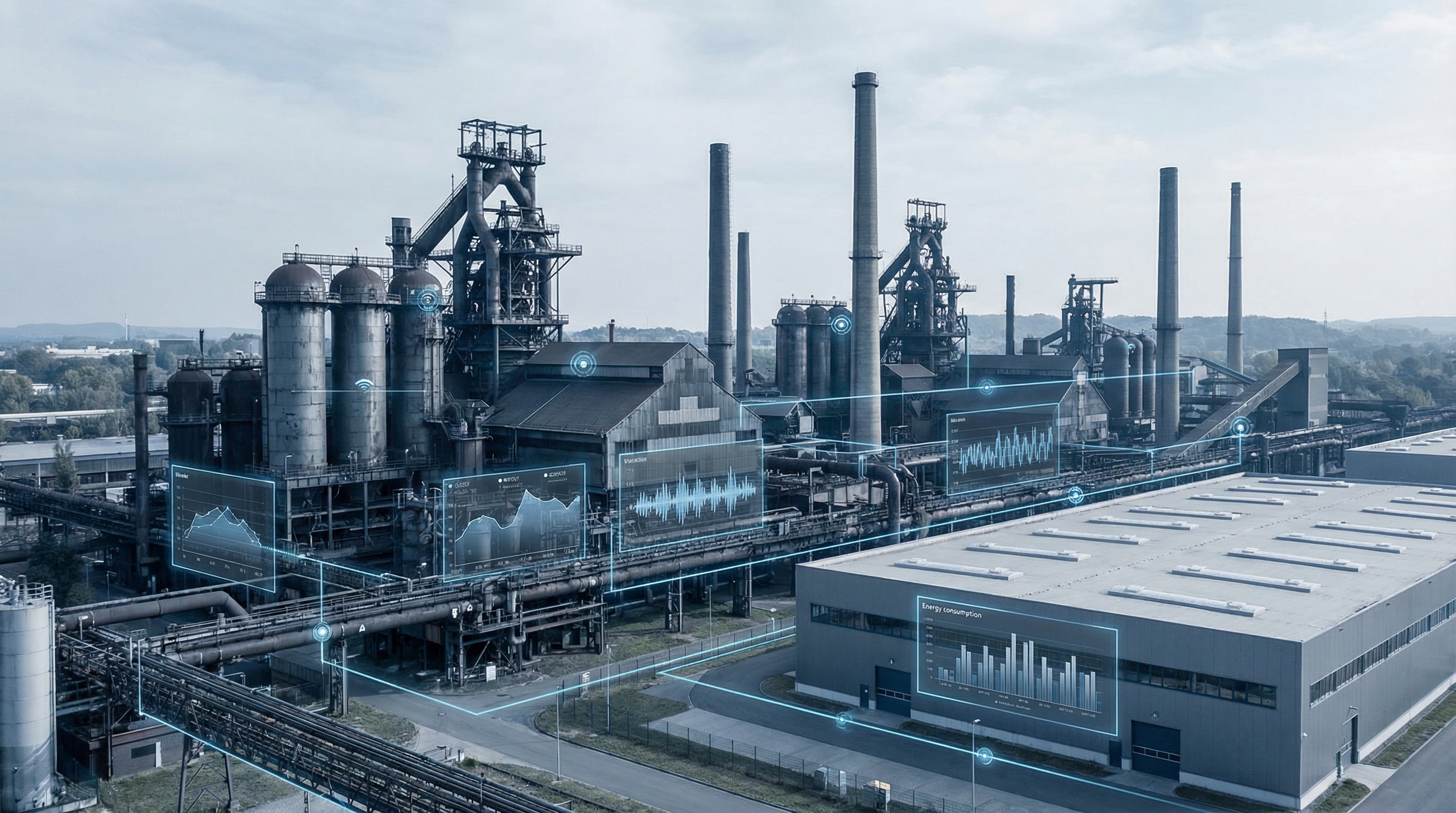
IoT retrofit in the Ruhr Area? We digitize your existing equipment - without production interruption. IoT solutions Ruhr Area · Contact
The Ruhr Area is industrial heartland. From Dortmund through Essen to Duisburg, thousands of production facilities have been running reliably for decades - but are digitally blind. Machine conditions are checked manually, energy consumption is estimated and maintenance follows schedules rather than actual need.
IoT system integration changes this: wireless sensors are mounted on existing machines without losing a single production day. Data flows into a central platform enabling condition monitoring, energy optimization and predictive maintenance.
The Ruhr Area: Germany's Industrial Heartland
With over 5 million inhabitants and industrial infrastructure spanning steel, mechanical engineering and chemicals, the Ruhr Area is the largest contiguous industrial region in Europe. The challenge: many SMEs have machines that are 15-30 years old. Complete replacement is too expensive. IoT retrofit is the economic alternative.
Industrial Locations in the Ruhr Area: Where IoT Retrofit Has the Greatest Impact
The Ruhr Area is not a monolithic industrial block - each city has its own industry focus and therefore its own IoT requirements:
- Dortmund - Logistics and Technology: The Port of Dortmund is one of Europe's largest canal ports with over 100 companies. Add the Technology Park at TU Dortmund and the Westfalenhuette site, where former steelworks have been converted to modern logistics centers. IoT focus: fleet management, cold chains, warehouse monitoring. More on IoT in Dortmund
- Essen - Energy Industry and Corporate Headquarters: Essen is home to E.ON, RWE, thyssenkrupp and Evonik. The corporate headquarters and associated facilities have massive energy consumption. IoT focus: energy monitoring in office complexes, building automation for corporate sites.
- Bochum - Automotive Suppliers and Mechanical Engineering: After the Opel closure, Bochum has reinvented itself as a supplier location. In the Gerthe commercial area and at MARK 51-7 (former Opel site), machine builders and automotive suppliers are located. IoT focus: condition monitoring for CNC machines and presses.
- Gelsenkirchen - Glass, Solar and Refineries: The glass industry (Pilkington/NSG) and the BP refinery in Scholven are energy-intensive operations. IoT focus: energy management, environmental monitoring in Ex zones, process temperature monitoring.
- Duisburg - Steel and Heavy Logistics: thyssenkrupp Steel in Bruckhausen, HKM in Huettenheim - Duisburg remains Europe's steel capital. The Port of Duisburg (duisport) is the world's largest inland port. IoT focus: heavy-duty condition monitoring, port logistics, emissions monitoring.
- Hagen - Metalworking in SMEs: Hagen is the city of the FernUniversitaet but also a center of metalworking with hundreds of SMEs in the Lenne Valley. Stamping operations, spring manufacturers, cold rolling mills - classic retrofit candidates. IoT focus: vibration and temperature monitoring on presses and rolling mills.
- Unna / Eastern Ruhr Area: The InduPark Unna and commercial spaces at the Kamener Kreuz form the gateway to the eastern Ruhr Area. Home to logistics companies, food producers and medium-sized manufacturing businesses. More on IoT in Unna
IoT Retrofit: The Approach
Non-Invasive
LoRaWAN sensors are attached externally to machines - via magnet, cable tie or screw mount. There is no modification to the PLC or control system. The production network remains completely separate. Sensors transmit via a separate LoRaWAN network.
Gradual
The retrofit happens in phases: first 5-10 sensors on the most critical machines. After the proof of concept, scaling to the entire facility. This minimizes risk and maximizes learning.
Integrable
IoT data can be integrated into existing systems via Node-RED:
- ERP: Maintenance notifications to SAP/Dynamics
- CMMS: Automatic work orders on anomalies
- Email/SMS: Alerting on critical conditions
- BI tools: Consumption data for controlling
Typical Applications in the Ruhr Area
Condition Monitoring for Mechanical Engineering
Vibration and temperature sensors on motors, gearboxes, pumps and compressors detect wear early. ThingsBoard shows the health status of every machine in real time.
Energy Management for Energy-Intensive Operations
Steel, glass, ceramics - energy-intensive industries particularly benefit from transparent consumption monitoring. Current clamps at every distribution panel, Grafana dashboards per system, automatic peak load warnings.
Quality Monitoring in Food Production
Temperature and humidity in production and storage rooms, cold chain monitoring, HACCP-compliant documentation - automatic and seamless.
Environmental Monitoring in Chemicals
Gas detection, temperature, humidity and pressure in sensitive areas. LoRaWAN sensors with ATEX certification for explosive atmospheres.
Case Study: Metalworker in Hagen-Hohenlimburg
Situation: A medium-sized cold rolling operation in Hagen-Hohenlimburg (the "cold rolling valley" of the Ruhr Area) with 85 employees and 12 production lines. The oldest rolling stands date from the 1990s, the newest from 2015. Previously: maintenance at calendar intervals (bearing replacement on the rolls every 6 months, regardless of condition). Unplanned downtime averaged 3 times per year at costs of 15,000-40,000 euros per incident (production loss + emergency repair). Energy costs of 480,000 euros per year without breakdown by system. Quality issues with temperature deviations in the cooling water circuit - only detected on the finished product.
IoT Solution:
- 2x Milesight UG67 Outdoor Gateways (hall roof north and south)
- 12x Vibration sensors (one per rolling stand main bearing)
- 12x Temperature sensors on rolling stand motors
- 6x Current clamps at main distribution panels (2 each per production hall)
- 4x Temperature sensors in the cooling water circuit
- 2x Flow sensors on cooling water pumps
- Alerting via Node-RED to maintenance manager and shift supervisor
Results after 9 months:
- Downtime prevented: Vibration sensor on rolling stand 7 showed a gradual increase in vibration amplitude of 340% over 3 weeks. Bearing replacement on a planned maintenance weekend instead of an unplanned weekday breakdown. Estimated savings: 35,000 euros (avoided production downtime + emergency surcharges).
- Maintenance intervals optimized: 4 of 12 rolling stands still showed perfect vibration values after 6 months - bearing replacement postponed. Material savings: approximately 8,000 euros per year in spare parts and labor time.
- Energy transparency: System 3 (built 1998) consumed 62% more electricity per ton of product than System 9 (built 2015). Investment application for drive modernization backed with concrete ROI data - payback in 2.3 years instead of estimated "sometime."
- Quality improvement: Cooling water temperature monitoring revealed: at outside temperatures above 28 degrees C, cooling water temperature rose 6 degrees C above target. Automatic alerting to the operator + rolling speed reduction at critical temperature - scrap rate reduced by 23%.
- Documentation for customer audits: Automotive customers increasingly require proof of process parameters. Seamless IoT documentation simplified and accelerated two customer audits (IATF 16949).
Industries in the Ruhr Area: Specific IoT Requirements
Steel Industry (Duisburg, Bochum, Dortmund)
The remaining steelworks in the Ruhr Area are high-temperature operations with extreme requirements: sensors must withstand ambient temperatures up to 60 degrees C, dust and vibration are omnipresent. Special IP67 housings and heat-resistant mounting are mandatory. Applications: rolling mill monitoring, crane monitoring, energy consumption of electric arc furnaces.
Chemicals and Refineries (Gelsenkirchen, Marl, Oberhausen)
The Marl Chemical Park (Evonik) and the BP Refinery Gelsenkirchen-Scholven are prime examples of facilities that benefit from IoT environmental monitoring. ATEX-certified sensors monitor gas concentrations, pressure and temperature in explosive atmospheres. The data serves not only safety but also proof of compliance with regulatory authorities.
Mechanical Engineering and Automotive Suppliers (Bochum, Hagen, Witten)
The Ruhr Area has hundreds of medium-sized machine builders and suppliers - many with 50-200 employees and a machine park that has grown over decades. Condition monitoring on CNC mills, lathes and hydraulic presses is the entry-level use case with the fastest ROI.
Logistics (Dortmund, Duisburg, Kamen)
The logistics industry in the Ruhr Area is growing massively - driven by e-commerce and the central location. Warehouses need temperature monitoring (especially food and pharmaceutical logistics), fleet management and energy monitoring of cooling and climate systems.
The IoT Stack for Industrial Operations
- Milesight: Industrial-grade sensors (IP67) and outdoor gateways
- ChirpStack: LoRaWAN network for the premises
- ThingsBoard: Central IoT platform with facility dashboard
- Grafana: KPI dashboards and energy reports
- Node-RED: ERP integration and automation
Hosted on German servers via merkaio Managed Hosting - GDPR-compliant with 24/7 monitoring.
Funding and Digitalization Grants
Many SMEs in the Ruhr Area are not aware: funding programs exist for IoT projects. The most important ones:
- Mittelstand Innovativ & Digital (MID): NRW funding program for digitalization, up to 15,000 euros grant
- go-digital: Federal funding program with up to 50% grant for consulting and implementation
- Digital Jetzt: Investment grant for SMEs up to 50,000 euros
We support with application processes and project planning - the IoT platform and sensors are eligible for funding.
Next Steps
- IoT solutions in the Ruhr Area - All services
- IoT solutions in Dortmund - Location
- IoT solutions in Unna - Location
- IoT solutions in Hamm - Location
- All IoT locations - Overview
- Get in touch - Free consultation
Frequently Asked Questions
Answers to important questions about this topic
IoT retrofit means equipping existing machines and systems with wireless sensors - without modifying the control technology. Sensors are mounted externally and capture vibration, temperature, power and other measurements. Data flows via LoRaWAN to a central platform.
IoT retrofit is relevant for metalworking, mechanical engineering, chemicals, food production, logistics and energy supply - the core industries of the Ruhr Area. Wherever machines run that are not yet digitally monitored.
Yes, via Node-RED, IoT data can flow into SAP, Microsoft Dynamics, DATEV and other ERP systems. Typical integrations include automatic maintenance notifications, consumption data for cost accounting and quality data for documentation.
Most IoT retrofit projects pay for themselves within 6-18 months through avoided downtime, energy savings and optimized maintenance cycles. A single avoided unplanned shutdown can refinance the entire investment.
Written by
Timo Wevelsiep
Co-Founder & CEO
Co-Founder of WZ-IT. Specialized in cloud infrastructure, open-source platforms and managed services for SMEs and enterprise clients worldwide.
LinkedInLet's Talk About Your Idea
Whether a specific IT challenge or just an idea – we look forward to the exchange. In a brief conversation, we'll evaluate together if and how your project fits with WZ-IT.
Trusted by leading companies













Timo Wevelsiep & Robin Zins
CEOs of WZ-IT