
NetBird vs. Twingate Comparison: Self-Hosted or Cloud ZTNA?


NetBird and Twingate are both modern Zero-Trust Network Access (ZTNA) solutions aiming to replace traditional VPNs. But while Twingate relies on a proprietary cloud solution with connector architecture, NetBird offers complete control through open source, self-hosting, and WireGuard-based peer-to-peer connections.
Enterprise VPN Flatrate: We offer Managed NetBird at a fixed price – unlimited users & devices, hosted in Germany. Try free for 14 days →
In this comparison, we'll show where both differ and which solution best fits your specific requirements.
More resources:
- NEW: NetBird Reverse Proxy – Securely Expose Internal Services
- → VPN Hub: All business VPN comparisons
- → Enterprise VPN Flatrate (no per-seat fees)
- → NetBird Managed Hosting by Birdhost
- NetBird vs. Tailscale: Self-hosted vs. cloud
- NetBird vs. ZeroTier: WireGuard instead of proprietary
- NetBird vs. Enclave: Open source vs. closed
Table of Contents
- Quick Overview: NetBird and Twingate
- Architecture and Technical Fundamentals
- Self-Hosting and Data Sovereignty
- Security and Access Control
- Usability and Administration
- Kubernetes Support
- DNS Management
- Cost Comparison
- Comparison Table
- When to Choose NetBird vs. Twingate
- Conclusion
- Our Services
Quick Overview: NetBird and Twingate
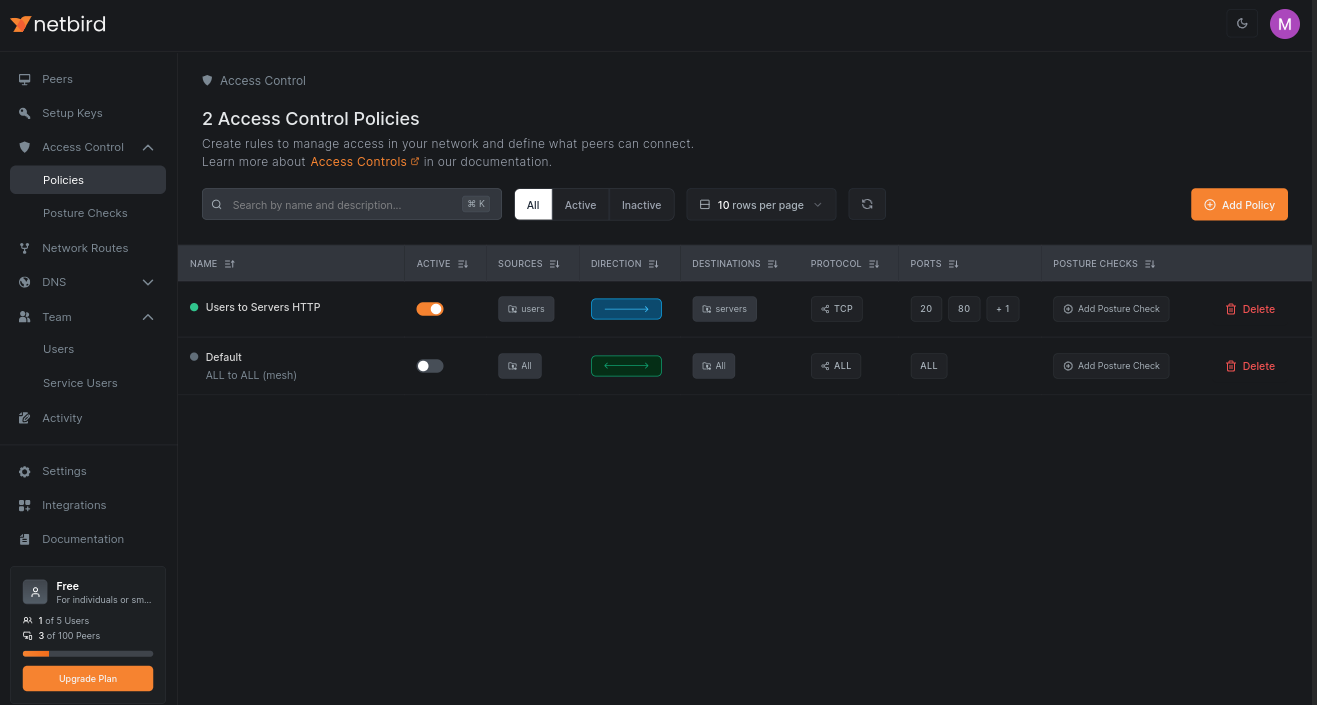 Screenshot from NetBird's cloud offering – the displayed user limitation only applies to the cloud version. Self-hosting has no limitations.
| Solution | Focus |
|---|---|
| NetBird | Open-source mesh VPN based on WireGuard with self-hostable control plane, decentralized peer-to-peer architecture, zero-trust approach, and modern web admin interface |
| Twingate | Cloud-based ZTNA solution with proprietary control plane, connector-based architecture, TLS encryption, and focus on fast remote access |
Both offer modern VPN alternatives with zero-trust principles – yet there are significant differences in architecture, hosting, control, and costs.
Architecture and Technical Fundamentals
NetBird: Decentralized Peer-to-Peer Architecture
NetBird uses a decentralized peer-to-peer mesh architecture. The core components are:
- Coordination Server (Management Service, Signal Service, Relay Server)
- NetBird Agents (Client application on devices)
How it works:
- Devices connect directly to each other (peer-to-peer)
- No central server routes traffic during normal operation
- The Coordination Server only facilitates the initial connection
- The Relay Server steps in for NAT/firewall issues
Protocol: NetBird uses WireGuard for encryption – known for simplicity, efficiency, and high performance.
Network Routes: Additionally, NetBird offers a connector-like feature called "Network Routes" that enables access to entire LANs or VPCs – similar to Twingate's Connectors, but more flexible.
Twingate: Hybrid with Connectors
Twingate uses a hybrid architecture with the following components:
- Controller (central, cloud-hosted, proprietary)
- Clients (on end devices)
- Connectors (deployed in remote networks)
- Relay infrastructure
How it works:
- The "Remote Networks" concept is central
- Each Remote Network requires at least one Connector
- Connectors serve as gateways to network resources
- Peer-to-peer connections between clients and connectors are possible
- Relays are used when needed
Protocol: Twingate uses TLS for encryption instead of a VPN protocol.
| Aspect | NetBird | Twingate |
|---|---|---|
| Protocol | WireGuard | TLS |
| Architecture | Peer-to-Peer Mesh | Hybrid with Connectors |
| Connector required | No (optional via Network Routes) | Yes, for each Remote Network |
| Control Plane | Open Source, self-hostable | Proprietary, cloud-hosted |
| Encryption | End-to-End (WireGuard) | TLS |
Assessment: NetBird's direct peer-to-peer connections typically offer lower latency and better scalability since no central connector acts as a bottleneck. Twingate requires more infrastructure (connectors in every network) but offers a clear gateway approach.
Self-Hosting and Data Sovereignty
This is one of the biggest differences between the two solutions:
NetBird: Full Self-Hosting
NetBird offers both a fully managed SaaS option and a self-hosted option for the Coordination Server:
- Management Service
- Management UI Dashboard
- Signal Service
- Relay (TURN) Service
All these components can be deployed on your own infrastructure – full control over all data and logs.
Twingate: No Self-Hosting Option
Twingate offers no self-hosting option for the server-side control plane:
- The Controller is part of Twingate's managed SaaS infrastructure
- Management console and services are operated exclusively by Twingate
- Only Connectors are deployed in the customer network
| Aspect | NetBird | Twingate |
|---|---|---|
| Fully Open Source | Yes | No |
| Self-hosting possible | Yes, completely | No |
| Web UI with self-hosting | Yes | N/A |
| Data sovereignty | 100% possible | Limited (Cloud) |
| External dependencies | None | Yes, Controller at Twingate |
Assessment: For companies with compliance requirements (GDPR, ISO 27001, government, healthcare), NetBird is clearly the better choice. Complete control over infrastructure is not achievable with Twingate.
Security and Access Control
NetBird
- WireGuard encryption: End-to-end encrypted peer-to-peer tunnels
- Identity-based access control: Management via intuitive web UI with group-based approach
- IdP integration: Okta, Azure AD, Google Workspace, Keycloak, and other OIDC/SAML providers
- Posture Checks: Access only when devices meet security requirements
- EDR integration: CrowdStrike Falcon and other solutions
- User/Group Provisioning: Automatic synchronization with IdP (SCIM)
Twingate
- TLS encryption: Secure tunnels between clients and connectors
- Identity-based access control: Groups and resources in admin dashboard
- IdP integration: Okta, Azure AD, Google Workspace, and others
- Posture Checks: Device Posture in Business plan
- EDR integration: CrowdStrike, Intune, SentinelOne (Business plan)
- Universal 2FA: Additional MFA requirements for resources
| Feature | NetBird | Twingate |
|---|---|---|
| Encryption | WireGuard (End-to-End) | TLS |
| Zero Trust ACLs | Yes, Web UI with groups | Yes, Web UI |
| Posture Checks | Yes (Business) | Yes (Business) |
| IdP Integration | Comprehensive | Comprehensive |
| User Provisioning (SCIM) | Yes (Team plan) | Yes (Business plan) |
| Activity Logging | Yes, SIEM integration | Yes, SIEM integration |
| Self-hosted = full control | Yes | No |
Assessment: Both solutions offer solid zero-trust security with similar enterprise features. NetBird's decisive advantage lies in complete transparency and control through open source and self-hosting – important for audits and compliance.
Usability and Administration
Twingate: Simple and Fast
Twingate impresses with easy setup:
- Client setup is straightforward
- Connector deployment via cloud marketplaces or container images
- User-friendly web console for daily administration
- Good overview of users, groups, resources, and policies
NetBird: Intuitive with Focus on Groups
NetBird offers a modern, intuitive web UI:
- Simple setup for clients and self-hosted servers
- Comprehensive group-based approach for network and access management
- Automatic peer configuration via groups
- Geographic display of connected devices
- Terraform, Ansible, CloudFormation support
| Aspect | NetBird | Twingate |
|---|---|---|
| Setup | Easy | Easy |
| Web UI | Modern, comprehensive | User-friendly |
| ACL management | Group-based (Web UI) | Resources/Groups (Web UI) |
| Multi-Tenant/MSP | Yes | Limited |
| Self-hosting | Yes | No |
| IaC support | Terraform, Ansible, etc. | Terraform |
Assessment: Both solutions are easy to use. NetBird offers slightly more intuitive management of complex networks through its group-based approach. Twingate is particularly suitable for teams that don't want to manage their own infrastructure.
Kubernetes Support
Twingate
Offers Kubernetes integration via:
- Helm Chart for easy installation
- Kubernetes Operator for automated deployment and management
NetBird
Offers Kubernetes support via:
- DaemonSet or Deployment configuration
- Sidecar, Proxy, or Network Router deployment
- More flexible options for different use cases
| Aspect | NetBird | Twingate |
|---|---|---|
| Helm Chart | Yes | Yes |
| Kubernetes Operator | No | Yes |
| Sidecar deployment | Yes | No |
| Network Router | Yes | No |
Assessment: Both support Kubernetes well. NetBird offers more flexibility in deployment methods, Twingate a more convenient operator approach.
DNS Management
Twingate
- Private DNS resolution for internal resources
- Integration with existing DNS infrastructure
- Access devices by hostname instead of IP
NetBird
- Access devices by name instead of IP
- Private DNS servers configurable via Distribution Groups
- Match and Search Domains are supported
Assessment: Both offer solid DNS management. NetBird offers slightly more flexibility with DNS resolution through Match/Search Domains.
Cost Comparison
NetBird: Self-Hosted = Free
Self-hosted NetBird is completely free – no license fees, no user fees, no hidden costs.
Cloud plans:
- Free: Basic features for small teams
- Team: $5/User/month – unlimited users, 100 Machines (+10 per user), SSO, SCIM
- Business: $12/User/month – Posture Checks, EDR integration, Device Approval
Special feature: High-Availability Routes and Exit Nodes are available in all plans, including the free tier.
Important distinction:
- NetBird (software): Open source, self-hostable, no per-seat licensing.
- WZ-IT Managed NetBird: Fixed monthly pricing for setup, operations, and support – learn more.
Twingate: SaaS with Rising Costs
Cloud plans:
- Free: Up to 5 users, 1 Admin, 10 Remote Networks
- Team: $6/User/month – up to 100 users, 3 Admins, 20 Remote Networks
- Business: $12/User/month – up to 500 users, 10 Admins, 100 Remote Networks
Important: The "Remote Networks" concept is central – each network needs at least one connector.
| Aspect | NetBird Self-Hosted | Twingate |
|---|---|---|
| License costs | None | From Free tier limit |
| User fees | None | $6-12/User/month |
| Unlimited devices | Yes | Plan-dependent |
| HA Routes/Exit Nodes | All plans (incl. Free) | ? |
| Infrastructure control | Complete | None |
Cost conclusion: For companies with many devices or long-term needs, self-hosted NetBird is economically unbeatable. Twingate can be attractive for small teams with the free tier, but costs rise quickly with user count.
Comparison Table
| Feature | NetBird | Twingate |
|---|---|---|
| Protocol | WireGuard | TLS |
| Architecture | Peer-to-Peer Mesh | Hybrid with Connectors |
| Fully Open Source | ✅ | ❌ |
| Self-Hosting | ✅ Complete | ❌ |
| Web UI (Self-Hosted) | ✅ | N/A |
| Zero Trust ACLs | ✅ Group-based | ✅ Resource-based |
| Posture Checks | ✅ | ✅ |
| IdP Integration | ✅ Comprehensive | ✅ Comprehensive |
| Kubernetes Support | ✅ Flexible | ✅ Operator |
| Network Routes | ✅ | ✅ (via Connectors) |
| Performance | ⭐⭐⭐⭐⭐ (WireGuard) | ⭐⭐⭐⭐ (TLS) |
| Ease of Use | ⭐⭐⭐⭐⭐ | ⭐⭐⭐⭐⭐ |
| Self-Hosted Costs | Free | Not possible |
| Data Sovereignty | 100% | Limited |
When to Choose NetBird vs. Twingate
Choose NetBird if you:
- ✅ Need complete control over your infrastructure (self-hosting)
- ✅ Prioritize data privacy and compliance (GDPR, your own servers)
- ✅ Value WireGuard performance and end-to-end encryption
- ✅ Don't want to deploy connector infrastructure in every network
- ✅ Want open source and auditability
- ✅ Want no ongoing license costs with self-hosting
- ✅ Manage multiple clients or teams (MSP)
- ✅ Operate hybrid cloud + on-prem environments
Choose Twingate if you:
- ✅ Don't want to manage your own infrastructure
- ✅ Find the connector concept fits your network architecture
- ✅ Are a small team (≤5 users) that can use the free tier
- ✅ Need features like Universal 2FA without an IdP
- ✅ Accept cloud dependency and ongoing costs
- ✅ Prefer an established enterprise solution
Conclusion
The comparison clearly shows: NetBird and Twingate are both strong ZTNA solutions, but follow different philosophies.
NetBird excels with:
- WireGuard-based end-to-end encryption
- Complete openness (100% open source)
- Self-hosting without compromises
- Decentralized peer-to-peer architecture (no connector requirement)
- Free operation without user fees
- Full control over data and infrastructure
Twingate scores with:
- Easy entry without own infrastructure
- Proven enterprise solution
- Clear connector-based gateway concept
- Convenient Kubernetes Operator
For companies focused on security, privacy, performance, and control, NetBird is the better choice. The combination of WireGuard performance, zero-trust security, complete self-hosting, and free usage is hard to beat.
Twingate remains interesting for teams without their own infrastructure resources or when the connector concept perfectly fits the existing network architecture.
Our Services
As an experienced IT service provider, we support you with evaluation, implementation, and operation of NetBird:
Consulting and Concept Development
- Analysis of your network requirements
- Zero-trust strategy development
Installation and Setup
- Self-hosted NetBird deployment (Docker, Kubernetes, Bare-Metal)
- Integration with existing identity providers (Azure AD, Okta, Keycloak)
- Access control configuration and policy design
- Migration from Twingate or classic VPNs
Managed Service
- Operation of NetBird infrastructure
- Monitoring and alerting
- Security updates and patches
- Support and troubleshooting
Contact
Want to switch from Twingate to a self-hosted solution? We'll be happy to advise you – without obligation and with expertise.
More NetBird Comparisons
Check out our other comparisons in the VPN Hub:
- NetBird vs. Tailscale – Self-hosted vs. cloud
- NetBird vs. ZeroTier – WireGuard vs. custom protocol
- NetBird vs. Enclave – Open source vs. proprietary
→ All VPN comparisons at a glance
Further Reading and Sources
Written by
Timo Wevelsiep
Co-Founder & CEO
Co-Founder of WZ-IT. Specialized in cloud infrastructure, open-source platforms and managed services for SMEs and enterprise clients worldwide.
LinkedInLet's Talk About Your Idea
Whether a specific IT challenge or just an idea – we look forward to the exchange. In a brief conversation, we'll evaluate together if and how your project fits with WZ-IT.
Trusted by leading companies













Timo Wevelsiep & Robin Zins
CEOs of WZ-IT