
Operate NetBird long term or replace Tailscale in a controlled way? Managed NetBird starts from €349.90 excluding VAT monthly and includes monitoring, updates, backups, support and Essential. The separate VPN migration sprint covers pilot users, parallel operation and rollback.
View the managed offering · Configure Managed NetBird · Plan the migration
NetBird and Tailscale are both modern mesh VPNs based on WireGuard - but they follow fundamentally different philosophies. Tailscale focuses on maximum convenience with a proprietary cloud solution, while NetBird offers complete control through open source and self-hosting.
In this comparison, we show how they differ and which solution fits which requirements best.
In short (as of October 2026): Tailscale is a SaaS with a closed coordination server, free for up to 6 users and then $8 or $18 per user and month. NetBird can be self-hosted completely and is free without user limits in the Community Edition; licence costs only apply for high availability, SCIM and device approvals (Commercial Starter: €2,000 per year). In throughput both are on par.
More resources:
Table of Contents
- Overview: NetBird and Tailscale
- Technology and Architecture
- Security and Access Control
- Reverse Proxy and Public Access
- Usability and Administration
- Cost Comparison
- Performance
- Headscale: Self-Hosting the Tailscale Control Server
- Comparison Table
- When to Choose NetBird or Tailscale?
- Conclusion
- Our Services
- Sources and Further Reading
Overview: NetBird and Tailscale
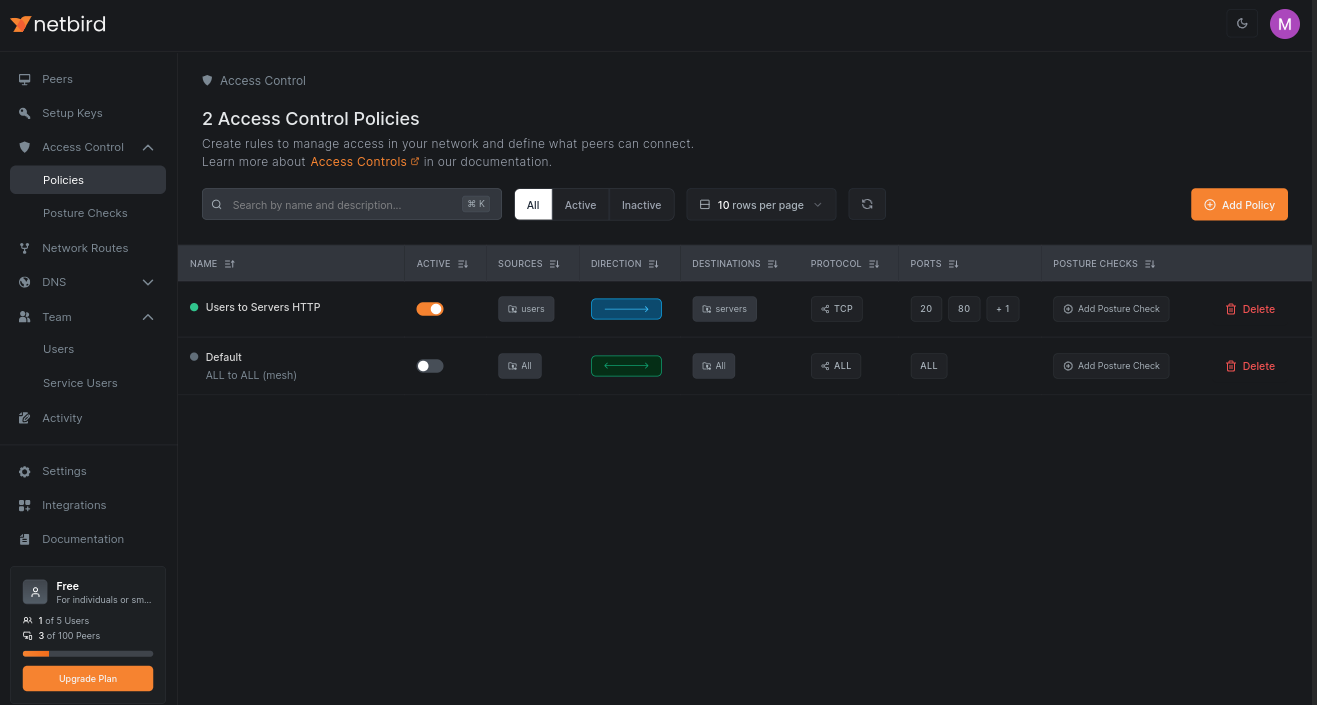 Screenshot from NetBird's cloud offering - the displayed user limitation only applies to the cloud version. Self-hosting has no limitations.
| Solution | Focus |
|---|---|
| NetBird | Open-source mesh VPN based on WireGuard with self-hostable control plane, Zero Trust approach, identity-based access control, and web admin interface |
| Tailscale | Mesh VPN based on WireGuard with centrally hosted control plane, very easy setup, and focus on plug-and-play remote access |
Both offer modern VPN/mesh functionality - yet there are clear differences in areas like hosting, control, usability, and costs.
Technology and Architecture
Similarities
Both solutions share important technical foundations:
- WireGuard as the basis: Modern VPN protocol standard with high performance, security, and efficiency
- Mesh network / Peer-to-Peer: Devices connect directly instead of through central gateways - reduces latency and improves performance
- Broad platform support: Servers, desktops, mobile, cloud, containers - both are flexible regarding OS and environment
- NAT Traversal: Automatic connection even through firewalls and NAT
Differences
The fundamental difference lies in the control plane:
| Aspect | NetBird | Tailscale |
|---|---|---|
| Control Plane | Open source (AGPLv3), self-hostable | Closed source, SaaS only |
| Client | Open source (BSD-3-Clause) | Core open source (BSD-3-Clause), Windows/macOS GUI closed |
| Self-Hosting | Fully possible | Not officially supported |
| Data Sovereignty | 100% possible | Limited (cloud) |
| Management | Web UI, identity-based | Admin console with visual policy editor and HuJSON policy file |
NetBird: Both the client and the control/coordination server can be self-hosted. The client is licensed under BSD-3-Clause, the server components management/, signal/, relay/ and combined/ under AGPLv3 (LICENSE in the NetBird repository). The self-hosted quickstart deploys a combined server with an embedded identity provider (Dex) on a Linux VM with 1 CPU and 2 GB RAM; external IdPs such as Entra ID, Google or Okta can be connected. You retain complete control over infrastructure and data.
Tailscale: The client daemon, the Linux and Android clients and the DERP relays are open source; the Windows and macOS GUIs and the coordination server are closed source (tailscale.com/opensource). The control plane is hosted exclusively by Tailscale. Self-hosting is only possible through the independent project Headscale, which Tailscale does not offer as a product.
Security and Access Control
Tailscale
- WireGuard encryption: Secure, private connections between devices
- Automatic NAT traversal: Peer discovery and mesh networks even through firewalls
- Zero Trust policies: Managed in the HuJSON policy file or, since October 2025, in the visual policy editor available on all plans
- MagicDNS: Automatic DNS resolution for devices in the network
NetBird
- WireGuard + Zero Trust: Encrypted peer-to-peer tunnels with comparable security level
- Identity-based access control: Management via web UI without JSON files
- Posture Checks: Access only when devices meet security requirements
- IdP Integration: SSO with Google, Azure AD, Okta, Keycloak
- Self-Hosting: All data stays in your own environment - important for data protection and compliance
| Feature | NetBird | Tailscale |
|---|---|---|
| WireGuard Encryption | Yes | Yes |
| Zero Trust ACLs | Yes, Web UI | Yes, visual editor or HuJSON |
| Posture Checks | Yes | Yes (Device Posture) |
| IdP Integration | Comprehensive | Comprehensive |
| Self-Hosted Possible | Yes | No (only Headscale) |
| Data in Own Environment | Yes | No |
Security Conclusion: Both are secure and modern. The big advantage of NetBird lies in management and governance with self-hosting - ideal for companies that prioritize control and compliance.
Reverse Proxy and Public Access
Since v0.65 (February 2026), NetBird includes a built-in reverse proxy - a feature that significantly shifts the comparison with Tailscale Funnel.
NetBird Reverse Proxy
The NetBird Reverse Proxy is integrated directly into the management server and allows exposing internal services via public domains - without port forwarding, without firewall rules:
- Automatic TLS certificates via Let's Encrypt - no manual certificate management
- Custom domains - use your own domains instead of generated subdomains
- Flexible authentication: SSO/OIDC with IdP integration, password, PIN, or public access - multiple methods can be combined simultaneously
- Path-based routing - consolidate multiple backend services under a single domain
netbird expose- CLI command for quick, temporary exposure with optional PIN/password/SSO protection- Self-hosted: All traffic flows through your own infrastructure, never through third-party services
Learn more: NetBird Reverse Proxy - Securely Expose Internal Services
Tailscale Funnel
Tailscale Funnel also exposes services publicly, but with limitations:
- Traffic must flow through Tailscale infrastructure
- No custom domains: Funnel only uses names in the tailnet domain
tailnet-name.ts.net(Funnel documentation) - Only ports 443, 8443 and 10000, with non-configurable bandwidth limits
- No granular auth options like SSO, PIN, or password
- No path-based routing for multiple backend services
Comparison
| Feature | NetBird Reverse Proxy | Tailscale Funnel |
|---|---|---|
| Expose internal services | ✅ | ✅ |
| Custom domains | ✅ | ❌ (only *.ts.net) |
| Automatic TLS certificates | ✅ Let's Encrypt | ✅ |
| SSO/OIDC authentication | ✅ | ❌ |
| PIN/password protection | ✅ | ❌ |
| Path-based routing | ✅ | ❌ |
| CLI quick expose | ✅ netbird expose |
✅ tailscale funnel |
| Self-hosted possible | ✅ | ❌ |
| Traffic control | Own infrastructure | Tailscale Cloud |
Reverse Proxy Conclusion: NetBird's built-in reverse proxy offers a significantly more powerful alternative to Tailscale Funnel - with custom domains, flexible authentication, and full traffic control. Tailscale Funnel remains simpler to set up but is functionally more limited.
Usability and Administration
Tailscale: Quick and Easy
Tailscale excels with minimal setup effort:
- Install client, login - done
- Very convenient for simple networks and remote access
- Ideal for small teams, homelabs, or quick setups
- Features like Taildrop (file transfer) and Funnel (public access)
Disadvantages:
- ACL and subnet routing configuration can get complex
- The visual policy editor covers standard rules; complex rule sets with many groups, tags and subnets still end up in the HuJSON policy file
- No self-hosting option - dependency on Tailscale infrastructure
NetBird: More Comfort with Complexity
NetBird offers more governance features:
- Web UI for management, access control, group management
- Even non-network admins can work with it
- Self-hosting or cloud-based - depending on needs
- Ideal for enterprises, DevOps teams, or MSP environments
The dashboard redesigned in 2026 splits the peers view into User Devices and Servers, making large networks much clearer. On top of that come identity-aware SSH instead of distributed SSH keys and, since v0.71, an IPv6 dual-stack overlay - we summarize the details in What's New in NetBird.
| Aspect | NetBird | Tailscale |
|---|---|---|
| Setup | Easy | Very easy |
| Web UI | Yes, comprehensive (also self-hosted) | Yes (SaaS admin console) |
| ACL Management | Web UI | Visual editor + HuJSON |
| Multi-Tenant | Yes | Limited |
| Self-Hosting | Yes | No |
| Reverse Proxy / Funnel | ✅ Reverse Proxy | ✅ Funnel |
| Taildrop | No | Yes |
Usability Conclusion: For simple setups and quick remote connections, Tailscale is often sufficient. For companies with multiple users, devices, or compliance requirements, NetBird is more comfortable and secure to operate through its web management and self-hosting option.
Cost Comparison
NetBird: Self-Hosted = Free
The self-hosted Community Edition is free - no license fees, no per-user fees, no per-seat billing.
- Community Edition: free, unlimited users and devices
- Included are SSO and MFA via your own identity provider, access controls, device posture checks, private DNS and audit logging
- Only operating costs of your own infrastructure
- Costs start with high availability, SCIM provisioning and device approvals: the commercial self-hosted licence Commercial Starter costs €2,000 per year for up to 50 users and 500 devices, Enterprise (50+ users) is priced on request (netbird.io/pricing, as of October 2026)
Buying the licence through us: WZ-IT is an official NetBird reseller. You can obtain Commercial Starter and Enterprise through us without detours - and our managed service adds qualified support that goes beyond NetBird's own email support.
For the comparison with Tailscale the distinction matters: the features that make remote access NIS2-capable cost nothing when self-hosting. What you pay for is operational comfort - resilience of the control plane and automated provisioning.
Important distinction:
- NetBird (software): Open source, self-hostable, no per-seat licensing.
- WZ-IT Managed NetBird: Fixed monthly pricing for setup, operations, and support - learn more.
If you would rather have NetBird operated for you, our VPN flat rate delivers exactly this model: a fixed price instead of per-seat or per-device fees.
NetBird Cloud is also available for teams without their own servers (as of October 2026, netbird.io/pricing):
| Plan | Price | Limits |
|---|---|---|
| Free | €0 | up to 5 users, 100 machines |
| Team | €6/user/month | 100 machines + 10 per user, SCIM, audit events |
| Business | €12/user/month | as Team, plus device approvals, MDM/EDR, posture checks, traffic events |
| Enterprise | on request | unlimited users and machines |
Tailscale: Cloud Dependency with Costs
Tailscale works with a freemium model and moved its business plans to seat-based billing with the pricing update v4 (8 April 2026) (as of October 2026, tailscale.com/pricing):
- Personal (Free): up to 6 users, unlimited user devices, 50 tagged resources included (each additional one $1/month); Personal Plus was retired
- Standard (formerly Starter): $8/user/month, unlimited users; since v4 including SCIM, device posture, user management APIs and webhooks
- Premium: $18/user/month
- Enterprise: custom pricing
- Existing paid plans keep their price for at least 12 months after the change
- Control plane is closed source and cloud-hosted
We break down how quickly seat pricing gets expensive as user counts grow in Tailscale Pricing 2026: When Self-Hosting Headscale or NetBird Is Cheaper.
| Aspect | NetBird Self-Hosted | Tailscale |
|---|---|---|
| License Costs | None | Free up to 6 users, then per seat |
| Per-User Fees | None | $8-18/user/month |
| Unlimited Devices | Yes | Personal: unlimited user-owned devices |
| Enterprise Features | Mostly included; HA, SCIM, device approvals from €2,000/year | Paid (Standard, Premium) |
| Infrastructure Control | Complete | None |
Cost Conclusion: Tailscale Standard costs $96 per user and year. The NetBird Commercial Starter licence (€2,000 per year) is reached at roughly 20 users, disregarding the exchange rate; without HA and SCIM the Community Edition incurs no licence costs at all. On top come server and operating costs for self-hosting, which the Tailscale price includes. For very small teams the Tailscale free tier remains the simplest option.
Performance
Both products use WireGuard and connect peers directly, so throughput is mostly limited by the network path, not by the overlay. The only public head-to-head measurement is a vendor benchmark by NetBird (Cloudflare Mesh vs NetBird vs Tailscale, 17 April 2026):
- Setup: Ubuntu 24.04, NetBird 0.68.3, Tailscale 1.96.4, iperf3 3.16, VMs at AWS, GCP and Hetzner plus residential connections in Berlin
- NetBird ran in userspace mode for the test so both P2P solutions operate under the same conditions; on Linux NetBird uses kernel WireGuard by default
- Example Hetzner Falkenstein to Nuremberg: NetBird 1,260/1,260 Mbps, Tailscale 1,300/1,220 Mbps (upload/download)
- Result according to the vendor: across all tests NetBird and Tailscale "traded back and forth within what we'd consider normal network fluctuation"
- Limitation stated in the article: the numbers are single test runs, not averages over many runs
Since the benchmark comes from one of the two vendors and uses single runs, it supports one conclusion: there is no relevant throughput difference between NetBird and Tailscale. Performance is not a deciding criterion between the two; hosting model, licence and cost are.
Headscale: Self-Hosting the Tailscale Control Server
Teams that want to keep the Tailscale clients but run the control plane themselves use Headscale. Headscale is an independent open-source project (BSD-3-Clause) that reimplements the Tailscale control server (GitHub); the current release is v0.29.5 (13 October 2026).
- Scope: deliberately a single tailnet, aimed at self-hosters, hobbyists and small organisations (project goal)
- Features: MagicDNS, subnet routers, exit nodes, ACLs and grants, Tailscale SSH, OIDC login; OIDC groups cannot be used in ACLs (feature list)
- Administration: CLI and API; there is no built-in web interface, web UIs are community projects (web UI overview)
- Support: community support via GitHub and Discord; there is no commercial licence
Headscale or NetBird? Headscale fits when the Tailscale clients should stay and a single tailnet is enough. NetBird provides its own web dashboard, an embedded identity provider, a reverse proxy and a commercial licence with HA as a self-hosted product. How Headscale, NetBird, Tailscale, ZeroTier and others compare is covered in our mesh VPN comparison 2026.
Comparison Table
| Feature | NetBird | Tailscale |
|---|---|---|
| Protocol | WireGuard | WireGuard |
| Licence | Client BSD-3, server AGPLv3 | Client core BSD-3, control server closed |
| Fully Open Source | ✅ | ❌ (client core only) |
| Self-Hosting | ✅ Complete | ❌ (only Headscale) |
| Web UI (Self-Hosted) | ✅ | ❌ (Headscale: community UIs only) |
| Zero Trust ACLs | ✅ Web UI | ✅ Visual editor + HuJSON |
| Posture Checks | ✅ | ✅ |
| IdP Integration | ✅ Comprehensive | ✅ Comprehensive |
| Reverse Proxy / Funnel | ✅ Custom Domains, Auth, Self-Hosted | ✅ Funnel (Cloud-only) |
| Taildrop (File Transfer) | ❌ | ✅ |
| MagicDNS | ✅ | ✅ |
| Performance | Comparable (vendor benchmark) | Comparable |
| User-Friendliness | ⭐⭐⭐⭐ | ⭐⭐⭐⭐⭐ |
| Self-Hosted Cost | Free (Community), €2,000/year (Starter) | Not possible |
| Cloud Price (as of October 2026) | Free up to 5 users, €6-12/user/month | Free up to 6 users, $8-18/user/month |
| Data Sovereignty | 100% | Limited |
When to Choose NetBird or Tailscale?
Choose NetBird if you:
- ✅ Need complete control over your infrastructure (self-hosting)
- ✅ Value data protection and compliance (GDPR, own servers)
- ✅ Want to minimize external dependencies
- ✅ Prioritize open source and auditability
- ✅ Want a web UI for easy management
- ✅ Want no ongoing license costs
- ✅ Want to securely publish internal services (Reverse Proxy with custom domains and auth)
- ✅ Manage multiple customers or teams (MSP)
- ✅ Operate cloud + on-prem hybrid environments
Choose Tailscale if you:
- ✅ Want the quickest start without own hosting
- ✅ Have a small team (up to 6 users) that fits the free tier
- ✅ Need features like Taildrop and Funnel
- ✅ Prefer minimal administration
- ✅ Accept cloud dependency and ongoing costs
- ✅ Need simple remote connections for homelab or prototyping
Still unsure which tool fits? The orientation workshop sorts out your requirements and delivers a prioritised topic list with a recommendation per topic. From €1,490 excl. VAT, remote.
Conclusion
The comparison clearly shows: NetBird and Tailscale are both strong WireGuard-based mesh VPNs, but they follow different philosophies.
NetBird excels with:
- Complete openness (100% open source)
- Self-hosting without compromises
- Web-based management for teams
- Free operation without per-user fees
- Full control over data and infrastructure
- Built-in reverse proxy with custom domains and auth
Tailscale scores with:
- Extremely easy onboarding
- Practical features (Taildrop, Funnel)
- Convenience without own infrastructure
- Good free tier for private users
For companies focused on data protection, costs, and control, NetBird is the better fit: identical WireGuard performance, Zero Trust policies, complete self-hosting and no licence costs in the Community Edition.
Tailscale remains interesting for quick setups, prototyping, or small teams - if you're willing to accept cloud dependency and potentially rising costs.
Our Services
As an experienced IT service provider, we support you with evaluation, implementation, and operation of NetBird:
Consulting and Conception
- Analysis of your network requirements
- Zero Trust strategy development
Installation and Setup
- Self-hosted NetBird deployment (Docker, Kubernetes, bare-metal)
- Integration with existing identity providers (Azure AD, Okta, Keycloak)
- Access control configuration and policy design
- Migration from Tailscale or traditional VPNs
Managed Service
- Operation of NetBird infrastructure
- Monitoring and alerting
- Security updates and patches
- Support and troubleshooting
Next step
A secure network without licensing traps?
We build your zero-trust network on WireGuard/NetBird - structurally safer than legacy VPN appliances and without per-user cost traps. Set up and managed by us.
Read next: NetBird vs ZeroTier · NetBird vs Twingate · NetBird expertise · Managed NetBird
Contact
Want to switch from Tailscale to a self-hosted solution? We're happy to advise you - no obligation, with expertise.
More NetBird Comparisons
Check out our other comparisons in the VPN Hub:
- NetBird vs. Twingate - Zero Trust vs. mesh VPN approach
- NetBird vs. ZeroTier - WireGuard vs. custom protocol
- NetBird vs. Enclave - Open source vs. proprietary
- Mesh VPN compared 2026 - the overview across all six solutions, architectures and licences
→ All VPN comparisons at a glance
Sources and Further Reading
- NetBird Documentation
- NetBird GitHub Repository
- Tailscale vs. NetBird (NetBird Knowledge Hub)
- Tailscale Documentation
- Tailscale Pricing
- Tailscale Blog: Pricing Update v4
- Tailscale Funnel Documentation
- Headscale - Self-hosted Tailscale Control Server
- WireGuard Whitepaper
- NetBird Reverse Proxy Documentation
- NetBird Knowledge Hub: Identity-Aware SSH
- NetBird Docs: Scaling Your Self-Hosted Deployment
- NetBird Docs: Self-Hosted Quickstart
- NetBird Pricing (Cloud and On-Prem)
- NetBird LICENSE (BSD-3-Clause / AGPLv3)
- NetBird Knowledge Hub: Cloudflare Mesh vs NetBird vs Tailscale (vendor benchmark)
- Tailscale Open Source
- Tailscale Blog: Visual Policy Editor GA
- Headscale Documentation: Features