
Smart City Arnsberg: IoT for Street Lighting and Environmental Monitoring in the Sauerland


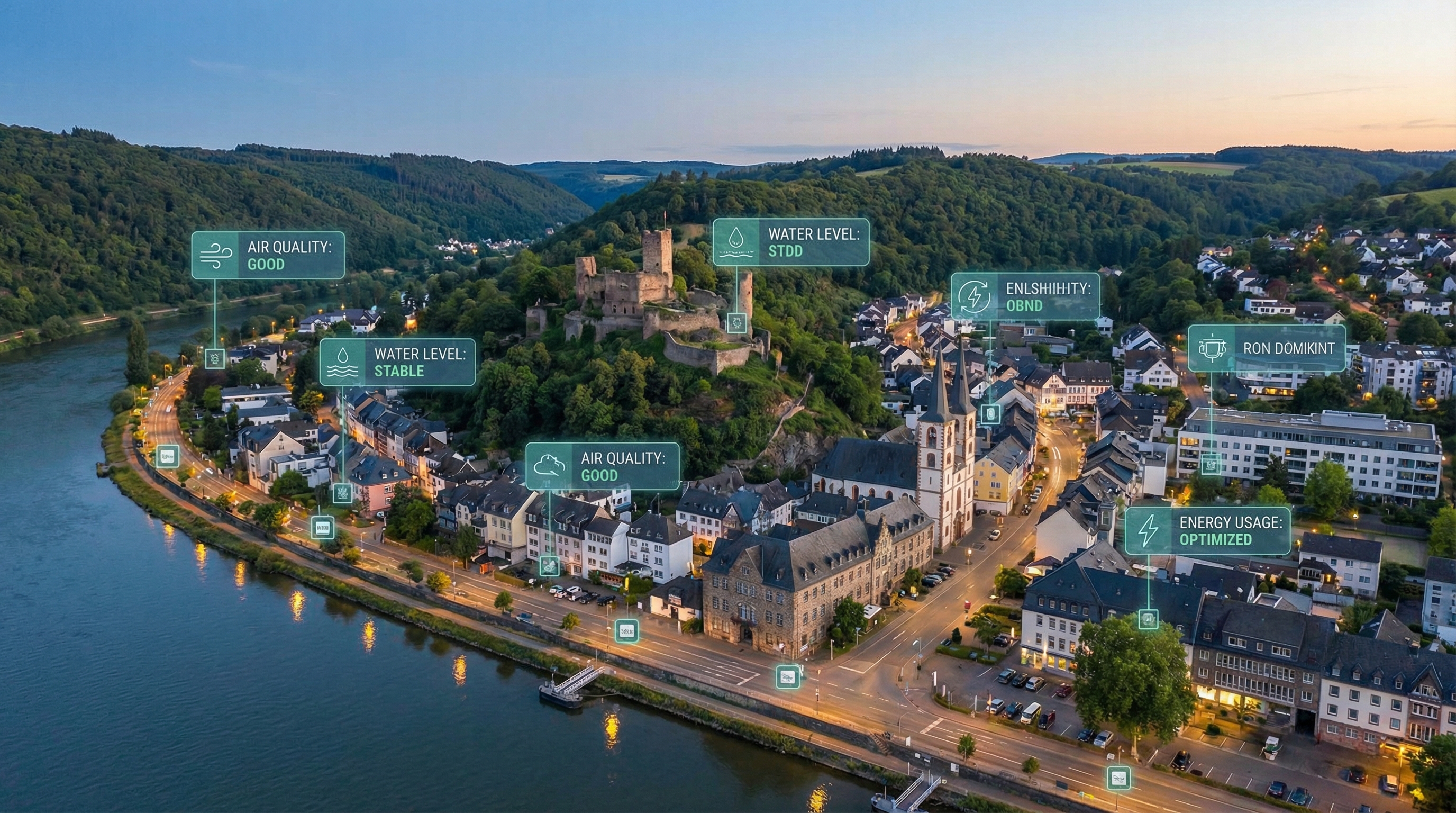
Smart city project in Arnsberg? IoT solutions for municipal tasks - from lighting to environmental monitoring. IoT solutions Arnsberg · Contact
Arnsberg, as the largest city in the southeastern Ruhr area foothills, faces typical municipal challenges: energy costs for street lighting are rising, environmental data is increasingly required, and citizens expect modern services. At the same time, budgets are tight.
IoT with LoRaWAN offers municipalities a cost-effective entry into smart city applications: one network, many applications - from lighting to environmental monitoring to waste management.
Arnsberg: A Unique City Structure
Arnsberg is a city of districts - and that makes IoT planning particularly interesting. Unlike a compact city, Arnsberg is distributed across several core areas:
- Alt-Arnsberg: Historic city center with castle ruins and narrow street network. Listed buildings, narrow lanes - classic lighting and climate challenges.
- Neheim: The economic center of Arnsberg with the pedestrian zone, retail and the Moehnesee within reach. Parking management and visitor flows are the topics here.
- Huesten: Commercial and industrial area with the leisure and industrial zone. Here municipal and industrial IoT requirements converge.
- Mueschede and Rumbeck: More rural districts with agriculture and residential areas. LoRaWAN range across the valleys is excellent thanks to elevated positions on the hills.
- Moehne Valley / Moehnesee Area: Tourism and recreation. Water level monitoring and environmental sensors have special significance here - particularly since the Moehnesee flooding events.
The topography of the Sauerland - valleys, hills, forests - places special demands on gateway positioning. At the same time, the elevated positions offer excellent locations: a gateway on the Arnsberg Schlossberg or on the Neheim church tower can cover large parts of the city area.
Smart City Applications for Arnsberg
Intelligent Street Lighting
Arnsberg's districts - from Alt-Arnsberg through Neheim to Huesten - have different lighting requirements. LoRaWAN controllers on street lights enable:
- Demand-driven control: Dimming during low-traffic periods, full brightness when needed
- Fault reporting: Automatic notification when a light fails
- Energy reporting: Consumption per street section in Grafana
- Central control: All lights via a single ThingsBoard dashboard
Environmental Monitoring
Air quality sensors on lamp posts and public buildings measure particulate matter, noise and climate data. Particularly relevant for Arnsberg:
- Air quality: Particulate matter measurement on main roads (e.g., Neheimer Markt)
- Flood early warning: Water level sensors on the Ruhr and Moehne rivers
- Temperature mapping: Urban heat island effects in densely built-up areas
Parking Space Management
Ground sensors in public parking spaces detect whether a space is free or occupied. Data can be shared with citizens via an app or display boards - less circling for parking, fewer emissions.
Waste Management
Ultrasonic sensors in waste containers measure fill levels. Waste collection can optimize routes and only service full containers. Typical efficiency improvement: 20-30% fewer empty runs.
One Network, Many Applications
The key advantage of LoRaWAN for municipalities: a single gateway network covers all applications. Gateways on the church tower, town hall and fire station simultaneously serve lighting, environmental sensors, parking sensors and waste monitors. Each new application uses the existing infrastructure.
The IoT Stack for Municipalities
- Milesight: Outdoor gateways and municipal sensors
- ChirpStack: Central LoRaWAN network for the city
- ThingsBoard: Municipal dashboard with map view
- Grafana: Reports for city council and administration
- Node-RED: Automations and citizen notifications
Hosted on German servers via merkaio Managed Hosting.
Case Study: Flood Early Warning in the Moehne Valley
Situation: The districts along the Moehne and Ruhr rivers are flood-prone - the events of recent years have made this abundantly clear. So far, there are water level stations from the state of NRW, but the data arrives with delays and does not cover all critical locations.
IoT Solution (Municipal Pilot Project):
- 3x LoRaWAN Gateways: Schlossberg (Alt-Arnsberg), Petrikirche (Neheim), Water Tower (Huesten)
- 6x Water level sensors at critical locations: Moehne (Mueschede, Neheim), Ruhr (Huesten, Alt-Arnsberg), tributaries in the side valleys
- 4x Rain gauges at exposed positions across the city area
- 3x Soil moisture sensors at known landslide-prone locations
Expected Benefits:
- Early warning: Combined data from rain, water level and soil moisture enables predictions 2-4 hours before critical water levels - enough time for evacuation measures
- Local accuracy: The municipal sensors supplement state data with local measurement points at critical bottlenecks (bridges, underpasses)
- Citizen information: Real-time water levels via the city app or website - transparency instead of uncertainty
- Long-term data: After several years, a data repository develops that provides well-founded support for urban planning (retention areas, building zones)
Arnsberg Forest and Tourism
The Arnsberg Forest and the Moehne Valley are popular recreational areas. Environmental sensors along hiking trails can measure air quality, UV exposure and soil temperature - data that is also relevant for tourism (e.g., hiking trail recommendations based on current conditions).
Huesten Industrial Area
Beyond municipal applications, the Huesten industrial area also has classic industrial IoT requirements: condition monitoring for paper mills and metalworkers, energy monitoring for businesses. The municipal LoRaWAN network can also be used for these applications - a win-win situation for the city and businesses.
Next Steps
- IoT solutions in Arnsberg - All services
- IoT solutions in Soest - Neighboring location
- IoT solutions in Bad Sassendorf - Neighboring location
- All IoT locations - Overview
- Get in touch - Free consultation
Frequently Asked Questions
Answers to important questions about this topic
Smart City means using IoT sensors for municipal tasks: controlling street lighting on demand, capturing environmental data, monitoring parking spaces, measuring waste container fill levels and monitoring water levels. This saves costs and improves service for citizens.
LoRaWAN controllers on street lights enable demand-driven control: dimming during low traffic, full brightness when needed. Light sensors automatically report failures. Typical energy savings: 30-50% compared to continuous operation.
Typical environmental data includes particulate matter (PM2.5/PM10), noise levels, temperature, humidity, UV radiation, CO2 and ozone. Sensors are mounted on lamp posts or buildings and transmit via LoRaWAN.
Yes, we support municipal IoT projects in the region. Arnsberg, as the second-largest city in the Hochsauerland district, offers significant potential for smart city applications. It is a 30-minute drive from Werl to Arnsberg.
Written by
Timo Wevelsiep
Co-Founder & CEO
Co-Founder of WZ-IT. Specialized in cloud infrastructure, open-source platforms and managed services for SMEs and enterprise clients worldwide.
LinkedInLet's Talk About Your Idea
Whether a specific IT challenge or just an idea – we look forward to the exchange. In a brief conversation, we'll evaluate together if and how your project fits with WZ-IT.
Trusted by leading companies











Timo Wevelsiep & Robin Zins
CEOs of WZ-IT