
NetBird vs. ZeroTier Comparison: Which Mesh VPN is the Better Choice?


Traditional VPNs with central gateways are reaching their limits in modern IT environments. Mesh VPNs like NetBird and ZeroTier offer a contemporary approach: direct peer-to-peer connections, easy management, and flexible network configuration.
Enterprise VPN Flatrate: We offer Managed NetBird at a fixed price – unlimited users & devices, hosted in Germany or location of your choice. Try 14 days for free →
But which solution fits your business better? In this comparison, we analyze both platforms in detail – from architecture and security to costs and typical use cases.
More resources:
- NEW: NetBird Reverse Proxy – Securely Expose Internal Services
- → VPN Hub: All business VPN comparisons
- → Enterprise VPN Flatrate (no per-seat fees)
- NetBird vs. Tailscale: Self-hosted vs. cloud
- NetBird vs. Twingate: Zero Trust alternative
- NetBird vs. Enclave: Open source vs. closed
Table of Contents
- Overview: NetBird and ZeroTier
- Architecture and Technical Foundations
- Security and Access Control
- Self-Hosting and Data Sovereignty
- Usability and Administration
- Cost Comparison
- Comparison Table
- When to Choose NetBird or ZeroTier?
- Conclusion
- Our Services
Overview: NetBird and ZeroTier
| Solution | Focus |
|---|---|
| NetBird | Open-source mesh VPN based on WireGuard with Zero Trust, identity-based access, full self-hosting option, and modern web UI |
| ZeroTier | Overlay/SDN VPN with proprietary protocol, virtual LANs (Layer-2/Layer-3), peer-to-peer connections, and broad platform support |
Both solutions aim to replace traditional VPNs and make corporate networks and remote access more flexible, secure, and modern.
Architecture and Technical Foundations
NetBird: WireGuard-based and Open Source
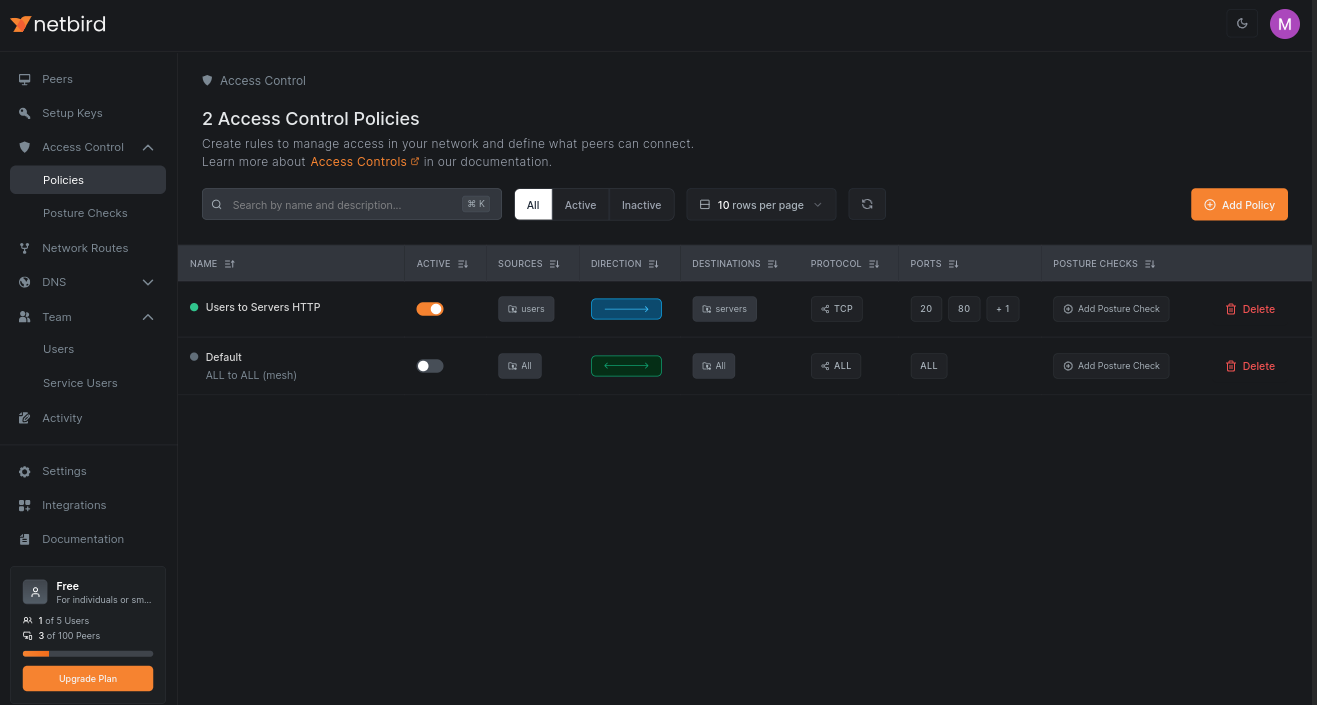 Screenshot from NetBird's cloud offering – the displayed user limitation only applies to the cloud version. Self-hosting has no limitations.
NetBird uses WireGuard as its cryptographic foundation – the most modern VPN protocol with excellent performance:
- Kernel Integration: On Linux, WireGuard runs directly in the kernel, enabling maximum speed
- Modern Crypto Stack: ChaCha20, Curve25519, BLAKE2s – proven, fast algorithms
- Minimal Code: ~4,000 lines vs. ~100,000 for OpenVPN – smaller attack surface
- Fast Connection Setup: Handshake in milliseconds instead of seconds
Communication is mostly peer-to-peer – devices connect directly to each other without traffic flowing through a central server. Management is handled through a central control plane with web UI and identity-based access control (SSO, MFA, IdP integration).
Particularly important: NetBird is fully open source under the BSD-3-Clause license. The entire code – client, server, and management plane – is available on GitHub and can be self-hosted.
ZeroTier: Proprietary Protocol with Layer-2 Support
ZeroTier uses a proprietary protocol (not WireGuard). It overlays network traffic and treats devices as if they were on the same local network.
The special feature: ZeroTier supports Layer-2 and Layer-3. This enables virtual LAN-like networks – including multicast, VLAN-like behavior, and more complex network segmentation.
| Aspect | NetBird | ZeroTier |
|---|---|---|
| Protocol | WireGuard | Proprietary |
| Kernel Mode | Yes (Linux) | No (Userspace) |
| Cryptography | ChaCha20, Curve25519 | Salsa20/12, Curve25519 |
| Layer-2 Support | No | Yes |
| NAT Traversal | ICE/STUN/TURN | Proprietary solution |
Assessment:
- If performance and transparency are important → NetBird with WireGuard is the better choice
- If virtual LAN functionality or Layer-2 features are needed → ZeroTier offers more flexibility here
Security and Access Control
Zero Trust with NetBird
NetBird follows a consistent Zero Trust approach: Access control is based on identity, not network segments. Only those explicitly authorized get access.
Security features:
- Identity-Based Access: Integration with SSO, MFA, IdP (Google, Azure AD, Okta, Keycloak)
- Granular ACLs: Detailed rules for which devices/users can access which resources
- Posture Checks: Access only when devices meet certain security requirements
- Device Approval: Admins must explicitly approve new devices
- Audit Logging: Complete logging of all access
- EDR/SIEM Integration: Connection to existing security tools possible
Through its fully open-source nature and self-hosting option, companies retain complete control over data, logs, and infrastructure – crucial for data protection and auditability.
Network Segmentation with ZeroTier
ZeroTier provides end-to-end encryption via its proprietary protocol. Peer-to-peer tunnels between devices work even through NAT/firewall via hole-punching.
Security features:
- Flow Rules: Flexible rules for network traffic
- Network Segmentation: Create virtual networks, group devices
- VLAN-like Configuration: Finer network separation possible
However: Enterprise features like central identity/MFA integration are less convenient than with NetBird. The self-hosted controller offers no user-friendly web UI – management is via API/CLI.
| Feature | NetBird | ZeroTier |
|---|---|---|
| Zero Trust ACLs | Yes, comprehensive | Yes, Flow Rules |
| Posture Checks | Yes | No |
| IdP Integration | Comprehensive (SSO, MFA) | Basic |
| Device Approval | Yes | Limited |
| Audit Logging | Yes | Limited |
Assessment: For companies with compliance, data protection, and identity management requirements, NetBird has a clear advantage. ZeroTier offers solid security, but governance and identity features are less "out-of-the-box".
Self-Hosting and Data Sovereignty
This is where one of the biggest differences between the two solutions shows:
NetBird: Complete Self-Hosting
NetBird can be fully operated on your own infrastructure:
- Management Server
- Signal Server (for NAT traversal)
- TURN Server (for relay connections)
- Dashboard UI
After installation, there is no connection to NetBird servers – full data sovereignty. The entire code is open source and auditable.
ZeroTier: Limited Self-Hosting
With ZeroTier, the situation is more complicated:
- The client is open source
- The central controller is proprietary and operated by ZeroTier
- Self-hosting is possible, but without a convenient web UI
- Management is via REST API / CLI – more technical know-how required
- Networks must initially be registered via ZeroTier infrastructure
| Aspect | NetBird | ZeroTier |
|---|---|---|
| Fully Open Source | Yes | No (client only) |
| Self-Hosting Possible | Yes, completely | Yes, limited |
| Web UI for Self-Hosting | Yes | No |
| Data Sovereignty | 100% possible | Limited |
| External Dependencies | None | Root server required |
Assessment: For companies with compliance requirements (GDPR, ISO27001, healthcare, financial sector, government), NetBird is the clearly better choice. Complete control over infrastructure is not achievable with ZeroTier.
Usability and Administration
| Aspect | NetBird | ZeroTier |
|---|---|---|
| Installation | Quick: Install client, SSO/login or setup key | Quick: Install client, join via Network ID |
| Web UI | Modern, intuitive, complete | Cloud: good / Self-hosted: none |
| Self-Hosted Management | Comfortable with web UI + API | API/CLI required, technical know-how needed |
| Multi-Tenant | Yes, well suited for MSP | Limited |
| Documentation | Good | Very good (longer market presence) |
| Community | Growing | Established, larger |
Assessment: NetBird offers a modern, clear interface and is well suited when security + user-friendliness + control are desired – without deep networking know-how.
ZeroTier is more suitable for networking professionals who need more flexibility at the Layer-2/Layer-3 level and don't mind doing more technical setup.
Cost Comparison
NetBird: Self-Hosted = Free
Self-hosted NetBird is completely free – no license fees, no per-user fees, no hidden costs. You only pay for server resources (own hardware or cloud VMs).
- Self-Hosted: Free, unlimited users and devices
- Cloud Version: Free tier available for small teams
Important distinction:
- NetBird (software): Open source, self-hostable, no per-seat licensing.
- WZ-IT Managed NetBird: Fixed monthly pricing for setup, operations, and support – learn more.
ZeroTier: Plan + Device-Based
ZeroTier works with a plan- and device-based model:
- Essential: $18/month incl. 10 devices, additional devices $2/month
- Scale: $179/month incl. 100 devices, additional devices $1.80/month
- Enterprise: Custom pricing
| Aspect | NetBird Self-Hosted | ZeroTier |
|---|---|---|
| License Costs | None | From $18/month (Essential) |
| Pricing Model | No per-seat costs | Plan + device-based |
| Unlimited Devices | Yes | No (limited by plan) |
| Enterprise Features | Included | Higher plans required |
Assessment: For companies with many devices or long-term needs, NetBird self-hosted is economically attractive – no ongoing license costs. ZeroTier can work for small installations, but costs increase with device count.
Comparison Table
| Feature | NetBird | ZeroTier |
|---|---|---|
| Protocol | WireGuard | Proprietary |
| Fully Open Source | ✅ | ❌ (client only) |
| Self-Hosting | ✅ Complete | ⚠️ Limited |
| Web UI (Self-Hosted) | ✅ | ❌ |
| Zero Trust ACLs | ✅ Comprehensive | ✅ Flow Rules |
| Posture Checks | ✅ | ❌ |
| IdP Integration (SSO/MFA) | ✅ Comprehensive | ⚠️ Basic |
| Layer-2 Bridging | ❌ | ✅ |
| Performance | ⭐⭐⭐⭐⭐ | ⭐⭐⭐⭐ |
| User-Friendliness | ⭐⭐⭐⭐⭐ | ⭐⭐⭐⭐ |
| Self-Hosted Cost | Free | Limited option |
| Data Sovereignty | 100% | Limited |
When to Choose NetBird or ZeroTier?
Choose NetBird if you:
- ✅ Need complete control over your infrastructure (self-hosting)
- ✅ Value data protection and compliance (GDPR, ISO27001)
- ✅ Want to implement Zero Trust with identity-based access (SSO, MFA)
- ✅ Prioritize open source and auditability
- ✅ Want a modern web UI for easy management
- ✅ Want no ongoing license costs with self-hosting
- ✅ Connect hybrid cloud/on-prem environments (servers, VMs, containers, Kubernetes)
Choose ZeroTier if you:
- ✅ Need Layer-2 features (virtual LANs, multicast)
- ✅ Want to build complex overlay network topologies
- ✅ Prefer an established solution with a large community
- ✅ Want to start with the Essential plan for small installations
- ✅ Have networking professionals on your team who prefer CLI/API management
Conclusion
The comparison clearly shows: NetBird and ZeroTier are both strong tools, but they follow different philosophies.
NetBird excels with:
- Modernity through WireGuard
- Complete transparency (100% open source)
- Comprehensive security (Zero Trust, Posture Checks, SSO/MFA)
- User-friendly web UI
- Free self-hosting without per-user fees
ZeroTier scores with:
- Layer-2 functionality for complex networks
- Long-term stability and large community
- Flexibility at the network level
For most companies – especially SMBs or businesses focused on security, data protection, costs, and easy management – NetBird is the better choice. The combination of WireGuard performance, Zero Trust security, full self-hosting, and free usage is hard to beat.
Those who need complex network architectures or Layer-2 features can gain more freedom with ZeroTier – at the expense of convenience and transparency.
Our Services
As an experienced IT service provider, we support you with evaluation, implementation, and operation of NetBird:
Consulting and Conception
- Analysis of your network requirements
- Zero Trust strategy development
Installation and Setup
- Self-hosted NetBird deployment (Docker, Kubernetes, bare-metal)
- Integration with existing identity providers (Azure AD, Okta, Keycloak)
- Access control configuration and policy design
- Migration from traditional VPNs or ZeroTier
Managed Service
- Operation of NetBird infrastructure
- Monitoring and alerting
- Security updates and patches
- Support and troubleshooting
Contact
Want to modernize your VPN infrastructure or switch to Zero Trust? We're happy to advise you – no obligation, with expertise.
More NetBird Comparisons
Check out our other comparisons in the VPN Hub:
- NetBird vs. Tailscale – Self-hosted vs. cloud
- NetBird vs. Twingate – Zero Trust vs. mesh VPN approach
- NetBird vs. Enclave – Open source vs. proprietary
→ All VPN comparisons at a glance
Further Reading and Sources
Written by
Timo Wevelsiep
Co-Founder & CEO
Co-Founder of WZ-IT. Specialized in cloud infrastructure, open-source platforms and managed services for SMEs and enterprise clients worldwide.
LinkedInLet's Talk About Your Idea
Whether a specific IT challenge or just an idea – we look forward to the exchange. In a brief conversation, we'll evaluate together if and how your project fits with WZ-IT.
Trusted by leading companies













Timo Wevelsiep & Robin Zins
CEOs of WZ-IT