IoT App & Platform Development Costs: What Does an IoT Project Really Cost?


Planning an IoT platform? We provide free consultation for your project – from MVP to production platform. Request consultation · IoT services overview
IoT platform projects are not standard app projects. Firmware, protocols, time-series databases, real-time dashboards – each layer has its own cost drivers. This article explains what an IoT platform really costs, which factors determine the price and why an open-source stack on dedicated infrastructure is the more economical long-term solution.
Table of Contents
- IoT App vs. Standard App: What Is Really Different?
- The Six Cost Layers of an IoT Platform
- Open-Source Stack vs. Proprietary Cloud Platforms
- GDPR and Data Sovereignty: Self-Hosted vs. Hyperscalers
- IoT MVP: The Right Starting Point Before the Full Platform
- Realistic Cost Ranges for IoT Projects
- IoT Mobile App: React Native for iOS and Android
- Our Approach at WZ-IT
- Further Reading
IoT App vs. Standard App: What Is Really Different?
Most app development cost calculators ask about screens, features and platform. For IoT projects, that falls short. Three fundamental differences drive costs in a different direction:
Hardware-in-the-Loop. An IoT platform cannot be developed without real device data. Sensors must be procured, gateways configured and protocols like MQTT or LoRaWAN connected. Development does not start with a Figma mockup – it starts with a functioning sensor setup. Test cycles are longer because hardware is always in the loop.
Time-Series Data at Scale. A temperature sensor measuring every 5 minutes generates 288 data points per day. With 100 sensors, that is 28,800 data points daily – over 10 million per year. Traditional relational databases are not optimized for this. IoT projects use specialized time-series databases like InfluxDB or TimescaleDB built for these query patterns.
Real-Time Requirements. Live dashboards with 30-second refresh rates, threshold alerts in under a minute, automatic escalation on sensor failure – these are not nice-to-haves but baseline requirements. The alerting pipeline (ThingsBoard Rule Engine + Grafana Alerting) must run continuously, not on user request.
These three factors make IoT projects structurally different from web or mobile app projects. The cost drivers are not primarily the number of screens but the complexity of the overall stack.
The Six Cost Layers of an IoT Platform
An IoT platform consists of six layers. Each has its own effort, technologies and cost drivers.
1. Device Connectivity
LoRaWAN gateways, MQTT brokers and a network server like ChirpStack form the foundation. Without working connectivity, there is no data. Costs include hardware procurement (gateways, sensors), gateway installation and configuration, and network server setup with payload decoders and device profiles.
Typical effort: 2–5 working days configuration + hardware costs.
2. Data Pipeline
Node-RED or a Node.js backend handles data normalization: protocol transformation, unit conversion, data validation and forwarding to the database. More complex setups include rule engines for conditional routing (e.g., only alarm data to a separate system).
Typical effort: 2–8 working days, depending on the number of data sources and transformation rules.
3. Time-Series Database
InfluxDB for pure time series or TimescaleDB when SQL compatibility and JOINs with master data are required. Setup includes schema design, retention policies (how long is raw data stored, when is it aggregated?) and query performance optimization.
Typical effort: 1–3 working days setup + ongoing optimization.
4. IoT Platform / Device Management
ThingsBoard as the central platform: tenant setup, device profiles, dashboard development, alarm rules and custom widgets. The Community Edition is free; the Professional Edition becomes relevant for multi-tenant scenarios.
Typical effort: 5–20 working days, depending on the number of dashboards and custom widgets.
5. Monitoring Dashboards
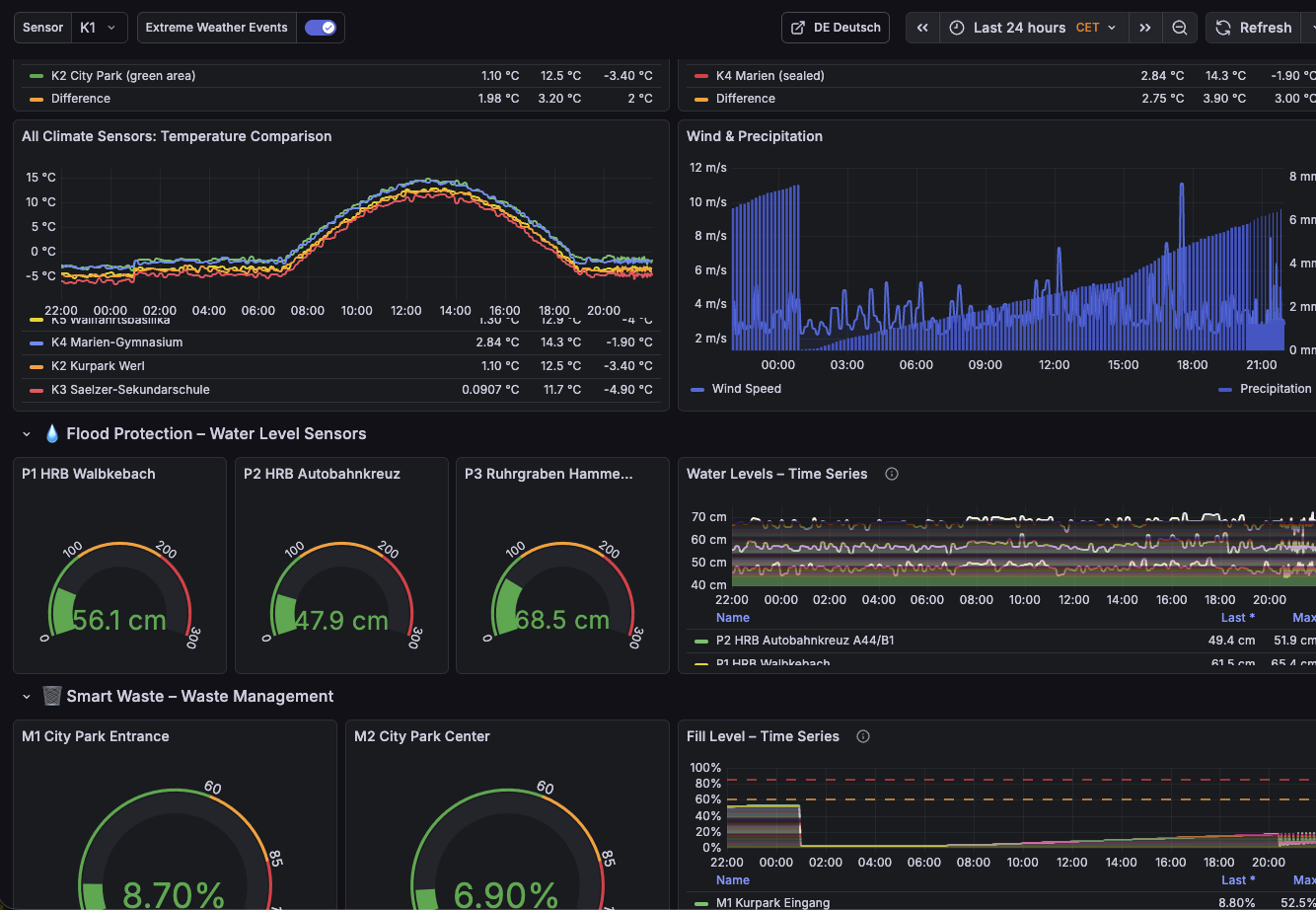
Grafana for ops teams and technical analysis: panel development, template variables, alerting rules and embedded panels. Grafana OSS is free and sufficient for most IoT projects.
Typical effort: 3–10 working days dashboard development.
6. Mobile App / Frontend
React Native for iOS and Android from a single codebase: ThingsBoard API integration, live sensor data, push alerts, offline sync. More details in the IoT Mobile App section.
Typical effort: 10–30 working days app development.
Open-Source Stack vs. Proprietary Cloud Platforms
The choice between an open-source stack and a proprietary cloud platform is the most important cost decision in an IoT project.
AWS IoT Core charges 1.00 USD per million MQTT messages plus 0.08 USD per million connection minutes plus data transfer costs. With 100 devices measuring every 5 minutes, costs reach approximately 200–600 USD/month for the connectivity layer alone – without database, dashboards or alerting. These costs scale linearly with device count. At 1,000 devices, that becomes 2,000–6,000 USD/month.
Azure IoT Hub uses tier models (S1, S2, S3). S1 costs 25 USD/month for 400,000 messages/day. Sounds affordable until the message limits are reached and an upgrade to S2 (250 USD/month) or S3 (2,500 USD/month) becomes necessary.
Open-source stack on Hetzner: ThingsBoard CE + ChirpStack + Grafana OSS + InfluxDB on a dedicated Hetzner server cost a fixed approximately 40–80 EUR/month for infrastructure – regardless of whether 50 or 5,000 devices are connected. No per-message costs, no vendor lock-in, full control over the stack.
The advantage is not "open source is free" – development costs for setup and customization still apply. The advantage is: the cost model is predictable and independent of device count. Starting with 50 devices and scaling to 5,000 costs barely more in infrastructure.
GDPR and Data Sovereignty: Self-Hosted vs. Hyperscalers
Sensor data from production facilities, logistics centers and healthcare environments is subject to strict data protection requirements. For many German and European companies, data residency on German servers is not optional but mandatory.
AWS IoT Core stores metadata in the US-East region by default unless explicitly configured otherwise. Even with EU regions (Frankfurt), the data processing agreement remains with a US parent company. For regulated industries – Industry 4.0 (OT data), healthcare (patient monitoring), food logistics (HACCP data) – this is a compliance risk.
A self-hosted Docker stack on Hetzner servers in Falkenstein (Germany) keeps all data exclusively in Germany. No third-party data processor, no data transfer to third countries. ThingsBoard, Grafana, ChirpStack, Node-RED and InfluxDB run entirely on dedicated infrastructure.
The additional cost for self-hosting versus cloud services is practically zero for small and medium projects – in fact, monthly infrastructure costs on Hetzner are significantly lower than on AWS or Azure. The effort lies in the initial setup and ongoing operations. Both can be covered via managed hosting.
IoT MVP: The Right Starting Point Before the Full Platform
The most common mistake in IoT projects: planning a complete platform before validating the value with real data. An MVP (Minimum Viable Product) approach not only saves costs but protects against misguided investments.
Phase 1: Pilot (5–10 devices, 4–8 weeks)
5–10 LoRaWAN sensors at one location. ChirpStack as network server, ThingsBoard for an initial dashboard, basic alerting. Goal: validate whether the sensor data is actually useful for the business problem, whether connectivity works in the specific environment (industrial halls have different RF conditions than offices) and what the real data volumes and alerting needs look like.
Phase 2: Rollout (20–100 devices)
Validated stack is rolled out to additional locations or device types. Node-RED pipelines for data normalization, Grafana for ops monitoring, expanded dashboards in ThingsBoard.
Phase 3: Platform (Multi-Tenant, API, Mobile App)
Multi-tenancy, ERP integration, React Native mobile app, custom widgets. Only in this phase is the full platform built – based on validated requirements from phases 1 and 2.
Realistic Cost Ranges for IoT Projects
The following table shows realistic investment ranges for IoT projects based on our open-source stack. Figures refer to development effort (services) – hardware costs are additional depending on the project.
| Project Stage | Description | Investment Range |
|---|---|---|
| IoT Pilot / MVP | 5–10 devices, ChirpStack + ThingsBoard, 1 dashboard, basic alerting | 5,000 – 15,000 EUR |
| IoT Platform (Mid-Market) | 20–100 devices, Node-RED pipeline, Grafana ops dashboards, advanced alerting | 15,000 – 50,000 EUR |
| IoT Platform with Mobile App | Above + React Native app for iOS and Android | 25,000 – 80,000 EUR |
| Enterprise / Multi-Tenant | Multi-tenancy, ERP integration, custom widgets, White-Label | 50,000 – 150,000 EUR |
| Ongoing Hosting Costs | Managed hosting in Germany (updates, monitoring, support) | 80 – 400 EUR/month |
Hardware costs (separate): Milesight sensors range from approximately 40–120 EUR per unit depending on type, a Milesight UG67 LoRaWAN gateway costs approximately 350–500 EUR. For a pilot with 10 sensors and 1 gateway, expect approximately 800–1,700 EUR hardware investment.
Why the range? The variance within each tier results primarily from: number of device types (different payload decoders), dashboard complexity (standard vs. custom widgets), integration depth (REST API vs. bidirectional ERP integration) and tenancy model (single-tenant vs. multi-tenant with customer hierarchy).
IoT Mobile App: React Native for iOS and Android
An IoT mobile app differs from a standard business app in several ways:
- Real-time connections: WebSocket connections to the ThingsBoard API for live sensor data with 10,000+ data points per chart
- Push alerts: Notifications from the ThingsBoard Rule Engine or Grafana Alerting on threshold violations
- Offline capability: Field technicians work in areas with poor connectivity – data must be cached locally and synchronized when connected
- Device pairing: Bluetooth or QR code-based device pairing for on-site commissioning
React Native enables developing an app for iOS and Android from a single codebase. This halves development effort compared to native development (Swift + Kotlin). ThingsBoard additionally offers an open-source Mobile Application as a starting point, which we customize for client-specific requirements – further reducing development time.
Typical costs: 8,000–30,000 EUR development effort, depending on offline logic complexity, number of device types and UI design scope.
More details: IoT Mobile App Development
Our Approach at WZ-IT
-
Free initial consultation. Clarify requirements, device types, data volumes and interfaces. Result: a shared understanding of the use case.
-
Technical concept + cost estimate. Stack recommendation (which combination of ThingsBoard, Grafana, ChirpStack and Node-RED makes sense for this project), rough development plan and transparent cost estimate.
-
IoT pilot / MVP. 4–8 weeks, 5–10 devices, validated stack with real data. You see the platform in action before investing in full development.
-
Rollout + managed hosting. Gradual scaling to production operations. German hosting on Hetzner, monitoring with Prometheus and Grafana, dedicated point of contact. Optional: managed operations via merkaio.
We take over the entire stack – from hardware recommendation through software development to ongoing operations. You focus on your core business.
Further Reading
- ThingsBoard, Grafana & ChirpStack: The IoT Stack Overview – How the components work together
- IoT Retrofit for Warehouses: LoRaWAN Without Wiring – Case study from Werl
- IoT Solutions Overview – All services at a glance
- IoT Platform Development – Multi-tenant IoT platforms
- Grafana Dashboards & Monitoring – Monitoring layer
- LoRaWAN Networks & Sensors – Connectivity layer
- IoT Mobile App Development – Mobile layer
Ready for your IoT project? We create a free technical concept with cost estimate – no obligation, tailored to your use case. Request now
Frequently Asked Questions
Answers to important questions about this topic
An IoT MVP with 5–20 devices, data pipeline and dashboard costs between 5,000–25,000 EUR depending on complexity. A production-ready platform with mobile app, multi-tenant and ERP integration typically costs 30,000–120,000 EUR in development effort plus ongoing hosting costs.
ThingsBoard Community Edition is open source and free. The costs arise from setup, configuration, device integration and dashboards – these are service costs, not license fees. The Professional Edition costs from 999 USD/month but is not necessary for most SME projects.
Grafana OSS is free. Costs arise from setup (1–5 working days depending on complexity), connecting to InfluxDB or TimescaleDB and dashboard development. Ongoing hosting costs on a German Hetzner server are approximately 20–80 EUR/month.
An IoT MVP with 5–10 LoRaWAN sensors, ChirpStack as network server, ThingsBoard dashboard and alerting typically costs 5,000–15,000 EUR total investment including hardware and initial configuration.
An IoT app with React Native (iOS + Android from a single codebase) for live data, push notifications and ThingsBoard integration typically costs 8,000–30,000 EUR in development effort – depending on complexity and number of device types.
AWS IoT Core charges per MQTT message plus connection time plus data transfer. With 100 devices sending hourly measurements, costs quickly reach 200–600 USD/month and scale linearly with device count. A self-hosted open-source platform on a Hetzner server costs a fixed 40–80 EUR/month – regardless of message volume.
Yes. The entire stack – ThingsBoard, Grafana, ChirpStack, Node-RED, InfluxDB – can run on German Hetzner servers in a Docker setup. No data sharing with AWS, Azure or Google.
Managed hosting including updates, monitoring and support costs 80–400 EUR/month depending on platform size. This includes servers, backups, security updates and a dedicated point of contact.
Written by
Timo Wevelsiep
Co-Founder & CEO
Co-Founder of WZ-IT. Specialized in cloud infrastructure, open-source platforms and managed services for SMEs and enterprise clients worldwide.
LinkedInLet's Talk About Your Idea
Whether a specific IT challenge or just an idea – we look forward to the exchange. In a brief conversation, we'll evaluate together if and how your project fits with WZ-IT.
Trusted by leading companies










Timo Wevelsiep & Robin Zins
CEOs of WZ-IT