


















Docker Deployment
Reproducible container-based deployments, CI/CD pipeline, infrastructure-as-code
Hetzner / Germany
Dedicated servers in German data centers, full GDPR compliance

Grafana Dashboards & IoT Monitoring
Custom dashboards, embedded panels, alerting and self-hosting. We build Grafana-based monitoring platforms for IoT, ops teams and data analysis - privacy-focused on German infrastructure.
- Grafana
- Open Source
- Alerting
- Multi-Tenant
- Privacy-focused


Grafana
What Is Grafana?
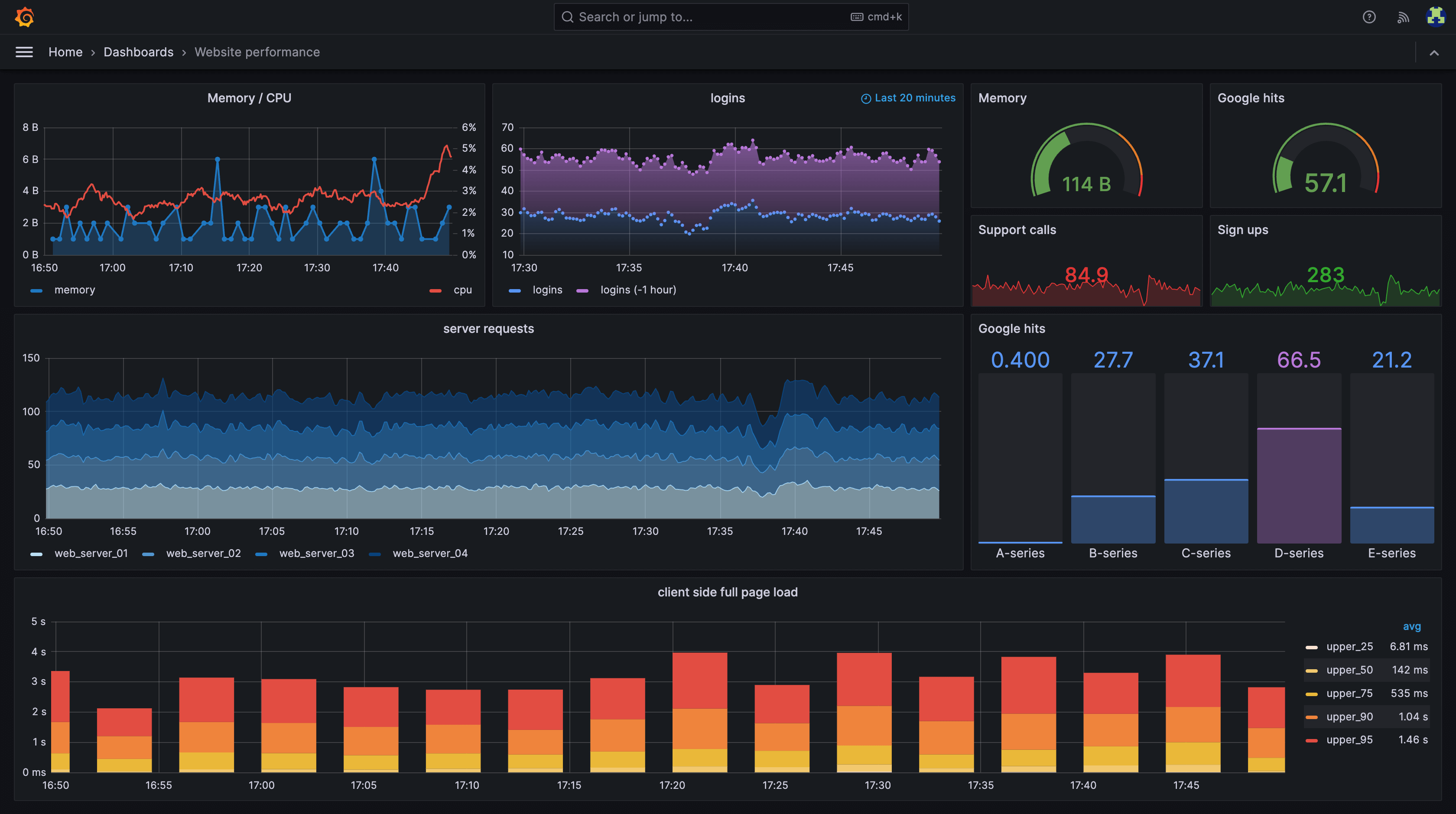
Grafana is the leading open-source platform for monitoring and data visualization. Over 20 million active instances worldwide, the industry standard for ops teams. Connects to any data source: InfluxDB, TimescaleDB, PostgreSQL, Prometheus, MQTT.
Grafana is, alongside ThingsBoard, one of the core foundations on which we build IoT platforms. Grafana is our tool for technical monitoring dashboards and ops teams. ThingsBoard is used for end-customer dashboards and device management. Both complement each other.
What We Do with Grafana
Custom Dashboards
Panels, layouts, template variables for dynamic views. Sensor time series, device status, KPIs - visualized for ops teams and management.IoT Alerting
Threshold alerts, anomaly detection, escalation logic. Notifications via email, Slack, PagerDuty, Teams - reliable, without polling.Embedded Panels
Embed Grafana panels into your own web portals, customer dashboards or React applications. Iframe and API-based, with token auth.Data Source Integration
InfluxDB and TimescaleDB for IoT time-series data, PostgreSQL for master data, Prometheus for system metrics - all in one dashboard.Multi-Tenant Views
Organizations and teams, role-based access control. Each team sees only its own data, its own dashboards, its own alerting rules.SCADA-Like Dashboards
Process visualization, equipment status, flowcharts for industrial environments. Canvas plugin for custom layout design.
Starting point
Who Is This For?
Grafana services for different starting points
Ops Teams
You have sensor data in InfluxDB or Prometheus and need structured dashboards and reliable alerting. We build the dashboards, you operate them.
Existing Grafana Instances
You already use Grafana and want custom dashboards, embedded panels or multi-tenant views. We extend your existing installation.
IoT Platform Operators
You run ThingsBoard or a custom platform and need Grafana as a monitoring layer for ops teams and technical analysis.
Agencies & System Integrators
You deliver IoT projects to your customers and need Grafana expertise for dashboards, alerting and embedded panels.
Running Grafana on dedicated infrastructure
Hosting & Operations
We deploy and operate Grafana on dedicated servers in German data centers. Docker-based, CI/CD-ready. No Grafana Cloud vendor lock-in - full control over data and configuration.
Monitoring the Monitor
Prometheus and Alertmanager monitor the Grafana instance itself - outages are detected immediately
Backups & Updates
Automated backups, regular updates, security patches in ongoing operations
Managed Operations
Updates, capacity planning and incident response in ongoing operations
Cloud Migration
Migration from Grafana Cloud to self-hosted: dashboards, data sources, alerting rules
Migration from Grafana Cloud to self-hosted including dashboard export, data source configuration and alerting transfer.
Data Sources
Grafana + Data Sources
The right database for your use case
InfluxDB
High-frequency sensor data, optimized for time series. Fast range queries across millions of data points.TimescaleDB
SQL-compatible, ideal when sensor data needs to be combined with master data (JOINs).PostgreSQL
Device configuration, tenant data, master data - query directly from the ThingsBoard database.Prometheus
System metrics of the IoT infrastructure: CPU, memory, MQTT broker stats, Node.js metrics.
We choose the data source based on your use case - not personal preference.
Grafana
OSS vs Enterprise
For most IoT projects, Grafana OSS is sufficient.
Free
Grafana OSS
- Free and open source. 50+ data sources, dashboards, alerting, teams and organizations. Limited SAML/LDAP. Fully sufficient for most IoT projects.
Licensed
Grafana Enterprise
- Licensed. Additional enterprise data sources, full SAML/LDAP, audit logs and advanced access control. For compliance requirements in regulated environments.
Stack
Grafana in the Overall Stack
Not isolated, but as the monitoring layer in the IoT stack

ThingsBoard
End-customer dashboards and device management. 600+ widgets, multi-tenant, rule engine - complements Grafana as the platform core.
InfluxDB
Time-series database for high-frequency sensor data. Primary data source for Grafana IoT dashboards.

Prometheus
Metrics of the IoT infrastructure: MQTT broker, Node.js, databases - natively integrated into Grafana.

Node.js
Custom backend for MQTT ingestion, WebSocket streams and data processing between sensors and Grafana.
Node-RED
Flow-based integration for data pipelines, protocol conversion and ERP connectivity.
React Native
Mobile apps with embedded Grafana panels: sensor dashboards, push alerting, offline sync.
A clearly defined check
Define the IoT architecture before the investment
Devices, protocols, data path, platform, network separation and operating model are assessed and documented.
IoT architecture checkfrom €1,490 excl. VATone-time
Frequently Asked Questions
Frequently asked questions about Grafana dashboards and IoT monitoring
- Grafana for technical monitoring dashboards, ops alerting and data analysis. ThingsBoard for end-customer dashboards, device management and multi-tenant. In our IoT projects, both run in parallel with a clear separation of responsibilities.
- Yes. Via embedded panels (iframe with auth token) or the Grafana HTTP API, dashboards and individual panels can be integrated into React applications, customer portals or mobile apps. We configure token auth and CORS settings.
- Over 50 data sources out-of-the-box: InfluxDB, TimescaleDB, PostgreSQL, Prometheus, MySQL, Elasticsearch, Loki and many more. For IoT projects, we primarily use InfluxDB (time series) and Prometheus (infrastructure metrics).
- Self-hosted on Hetzner. Full control, no vendor dependency, privacy-focused without public cloud. Grafana Cloud has advantages for very small teams without their own infrastructure - for IoT projects with sensor data in Germany, we recommend self-hosted.
- For most IoT projects, Grafana OSS is sufficient. Enterprise becomes relevant for compliance requirements (audit logs), full SAML/LDAP or enterprise-only data sources. We advise on the most cost-effective edition decision.
- Yes. Via organizations and teams, multi-tenant structures can be implemented: each organization has its own dashboards, data sources and alerting rules. For true tenant isolation with customer hierarchy, we recommend ThingsBoard as a complement.
- Grafana Alerting (Unified Alerting since v9) is production-proven and supports multi-channel notifications (email, Slack, PagerDuty, Teams), escalation logic and silence rules. For critical alarms, we additionally recommend Alertmanager as a routing layer.
- Yes. We export dashboards, data source configurations and alerting rules, deploy Grafana on Hetzner and configure the new instance. Including monitoring setup and managed operations option.
Knowledge
Further guides
In-depth knowledge from our knowledge base.
Guides
Related Tutorials & Guides
- Smart Logistics Dortmund: IoT Monitoring for Port Operations and Distribution CentersDortmund is one of Germany's most important logistics hubs. The Port of Dortmund as Europe's largest canal port, the former Westfalenhuette site as a logistics...
- ThingsBoard, Grafana & ChirpStack in the Modern IoT Stack: Roles, Integration and Use CasesIoT projects face a central challenge: Which components are needed for a functional IoT stack? From the sensor layer to data collection and visualization, various...
Reviews & projects
Client feedback and projects worldwide
WZ-IT moved our studio infrastructure from decentralised individual devices to a central platform: every site is securely connected via VPN, new devices are onboarded automatically and an entire site is provisioned from a template, without manual steps on location. What impressed me most is the breadth and depth of their knowledge: Timo and Robin are not a typical IT provider who sets up a server and leaves. The two of them think their way into highly complex infrastructure and software topics, work through every requirement we put in front of them, and build networking, provisioning and operations so that everything fits together in the end. WZ-IT is an excellent partner for complex software, network and architecture projects.
 Steve KirchnerManaging Director, nextGYM GmbH
International
Built in Germany's Ruhr Valley. Running worldwide.
WZ-IT designs, develops and operates infrastructure and software for clients in Germany and internationally. We deliver projects remotely and continue supporting them in ongoing operations after go-live.
Selected projects
- LiveRemote access platform for distributed water treatment plantsABCO Water Systems · Australia · Secure Access & OT

- 81%AWS migration with substantially lower operating costsEVA Real Estate · UAE · Cloud exit & infrastructure

- 98%Provision new sites in minutes instead of hoursnextGYM GmbH · Germany · Automation & IoT
Read client reviews
- Integrate a local AI solution
- Virtualize with Managed Proxmox
- Build a high-availability Proxmox cluster
- Secure your Proxmox & backup setup
- Modernize your infrastructure - sovereign
- Plan a sovereign open-source stack
- Modernize your legacy software
- Cut cloud cost - up to −81%
- Design an open-source AI architecture
- Get collaboration fully managed
- Ship your prototype to production
- Connect sites and clusters securely
Enquiry
Assess Grafana and data visualisation requirements
Name the data sources, users, and metrics that should become visible.
- Straight with Timo and Robin - no sales team, no pitch
- An honest take, including when we are not the right fit
- Concrete next steps for infrastructure, software or AI
No risk: worst case, you leave with a clearer understanding of your project than before.


WZ-IT's advice on our Azure migration was technically sound and completely non-binding right from the intro call - we took away a great deal.