


















 React Native
Cross-platform mobile framework for iOS and Android. One codebase, native performance, direct access to BLE, camera, and push services.
TypeScript
Type-safe code in the app and backend. Fewer runtime errors, better maintainability, shared types between app and API.
IoT Mobile App Development.
React Native apps for IoT devices: device pairing via BLE and MQTT, real-time sensor data, offline sync, and push notifications. One codebase for iOS & Android - privacy-focused on European infrastructure.
- React Native
- TypeScript
- BLE / Bluetooth
- Offline-First
- Privacy-focused


React Native
IoT Mobile Apps with React Native - one codebase, two platforms
React Native is the most efficient way to build IoT apps for iOS and Android simultaneously. One codebase, native look & feel, direct access to BLE, camera, push services, and local storage. For typical IoT requirements like device pairing, sensor data streams, and offline capability, React Native delivers native performance - without duplicating development effort.
We don't just build the app - we understand the layers beneath it: device protocols (BLE, MQTT), backend APIs, and data infrastructure. The result is an app that communicates seamlessly with your IoT hardware - including offline-first logic, background sync, and reliable push notifications. Hosted in Germany, privacy-focused.
What we cover for IoT mobile apps
Cross-Platform with React Native
One codebase for iOS and Android with native look & feel. Significantly faster development and easier maintenance than two native apps - without compromising on performance or UX.Device Pairing & Communication
BLE pairing, MQTT messaging, and WiFi connections directly from the app. We implement robust pairing flows, bidirectional communication, and firmware update mechanisms via the app.Offline-First & Sync
The app works without a network: local data storage, background sync on reconnection, and conflict resolution. Essential for IoT in the field, inside buildings, or in industrial environments.Real-Time Sensor Data in the App
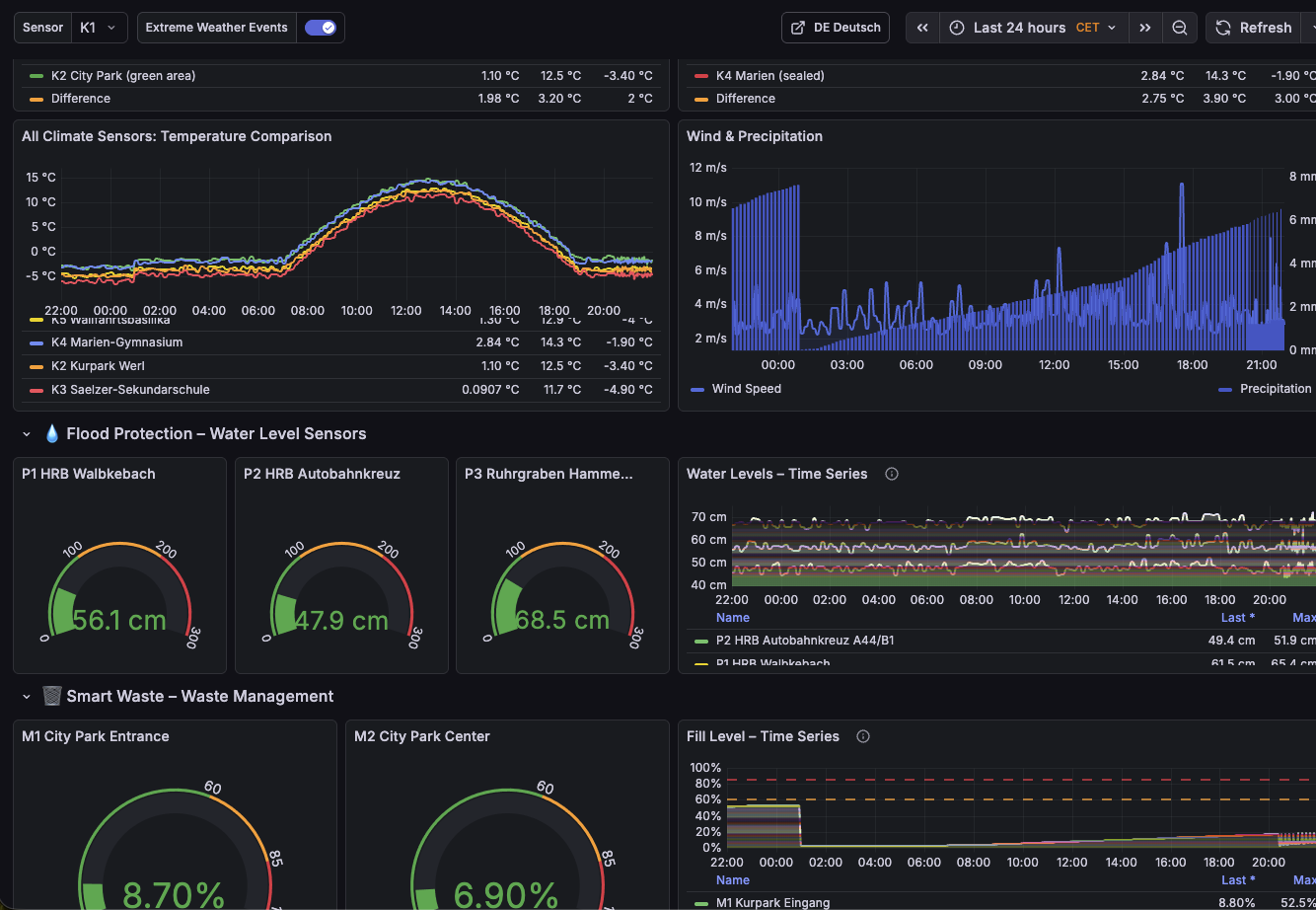
Live visualization of sensor readings with charts, gauges, and status indicators. Supabase Realtime and WebSocket streams for instant updates - no manual refresh needed.Push Notifications & Alerting
Threshold breaches, device status changes, critical events - delivered reliably via FCM (Android) and APNs (iOS). Configurable thresholds, escalation logic, and silent notifications.App Store Deployment
We handle the entire release process: iOS App Store and Google Play Store. CI/CD pipeline, TestFlight and Internal Testing, OTA updates via CodePush for fast iterations after go-live.
Use cases
Projects we're the right partner for
From companion apps to enterprise fleet apps
Companion Apps for Hardware
You build a device and need the app to go with it: pairing via BLE, configuration, firmware updates, displaying sensor data. We deliver the complete companion app for iOS and Android.
Field Service Apps
Technician apps for on-site maintenance and commissioning. QR code scanning, BLE diagnostics, offline logging, and automatic sync on the next network contact.
Fleet & Asset Management
Manage device fleets via the app: status, location, battery level, and alarms for hundreds to thousands of devices. Filterable lists, map view, and batch actions.
Energy & Building
Monitor heating, climate, and power consumption via the app. Manage rooms and meters, view consumption data, receive push alerts on anomalies - all on mobile for facility managers.
Water & Environment
View water levels, water quality, and environmental data on mobile. Push notifications for critical readings. Ideal for distributed sensor networks with LoRaWAN connectivity.
Agriculture
Control soil moisture, weather data, and irrigation via the app. Check LoRaWAN sensor status on mobile, configure thresholds, receive alerts - even out in the field.
Stack
Our Mobile IoT Technology Stack
Proven technologies for high-performance IoT mobile apps
BLE / Bluetooth Low Energy
Energy-efficient protocol for direct device pairing. Pairing, data transfer, and configuration without an internet connection.
MQTT
Lightweight publish-subscribe protocol for IoT messaging. Low bandwidth requirements, reliable delivery, ideal for sensor data over the network.
LoRaWAN
Wireless protocol for battery-powered sensors with ranges up to 15 km. The app displays data from LoRaWAN devices - water levels, soil moisture, environmental data - without the device needing to be directly reachable.
 Supabase
Auth, realtime subscriptions, and storage for the app. Self-hosted for GDPR compliance, realtime channels for live data in the app.
 Node.js
Event-driven backend for MQTT ingestion, WebSocket streams, and REST APIs. Processes sensor data and delivers it to the mobile app.
 ThingsBoard
IoT platform for device management and rule engine. The app connects to ThingsBoard via REST and MQTT APIs - manage devices, retrieve data, trigger rules.
ThingsBoard expertise
 Grafana
Dashboards and alerting. Panels can be embedded into the mobile app or used as reference visualizations for custom charts.
Grafana expertiseInfluxDB
Time-series database for high-frequency sensor data. The app queries historical and current readings via the API.
TimescaleDB
SQL-compatible time-series database. Ideal when the app needs to combine complex queries with master data.
Process
How we build your IoT mobile app
Structured, transparent, and adapted to your pace
- 01
Discovery & Architecture
Clarify app requirements, device protocols, and user flows. Which devices, which data, which offline scenarios? The result is a clear technical roadmap.
- 02
UX/UI Design
Mobile app wireframes, pairing flows, and offline scenarios as an interactive prototype. You test the app logic on your device before a single line of code is written.
- 03
Development
App and backend are developed in parallel. Two-week sprints with a demo at the end of each sprint - on your test device, not just in the simulator.
- 04
Integration & Testing
End-to-end testing with real IoT devices. BLE pairing under real-world conditions, offline scenarios, push delivery, and load tests with simulated sensor data.
- 05
App Store Release
TestFlight and Google Play Internal Testing for your review. Then live release to both stores. CI/CD pipeline for fast updates after go-live.
Why WZ-IT
Why WZ-IT for your IoT mobile app?
The difference between an app agency and an IoT-experienced development partner
IoT experience, not a generic app agency
We know BLE pairing flows, MQTT subscriptions, offline sync patterns, and sensor data streams. No learning curve at your expense - we have IoT apps in production.One codebase, two platforms
Years of React Native expertise. One codebase for iOS and Android, native modules where needed, cross-platform where possible. Faster development, easier maintenance.Backend-aware mobile development
We build the app and the API together - no coordination overhead between an app team and a backend team. Device protocols, data models, and API contracts from a single source.Privacy-focused
Hosted in Germany, Supabase self-hosted, encrypted transmission. No data in US clouds. Open-source stack without proprietary lock-in.
A clearly defined check
Define the IoT architecture before the investment
Devices, protocols, data path, platform, network separation and operating model are assessed and documented.
IoT architecture checkfrom €1,490 excl. VATone-time
Frequently Asked Questions
Answers to the most important questions about IoT mobile app development
Mobile App Development
- We develop IoT mobile apps with React Native for iOS and Android from a single codebase. This includes device pairing via BLE and MQTT, real-time visualization of sensor data, offline-first logic with background sync, push notifications for threshold breaches, and the complete App Store release. We also develop the associated backend and API on request.
- iOS and Android simultaneously, from a single codebase with React Native. The app looks native on both platforms and uses platform-specific features like BLE, push notifications, and local storage. Where native access is required, we integrate targeted native modules.
- Yes. If you already run an IoT backend, a ThingsBoard instance, or your own API, we develop the mobile app as a frontend for it. We integrate with existing REST, MQTT, or WebSocket interfaces - the app does not have to be built end-to-end by us.
Technology & Devices
- One codebase for both platforms significantly reduces development time and cost without compromising on performance or UX. For typical IoT requirements like BLE device pairing, offline sync, and push notifications, React Native delivers native performance. Where a native module is truly necessary - for example, for specialized BLE chipsets - we integrate it specifically.
- BLE (Bluetooth Low Energy) for direct device pairing without internet, MQTT for sensor data over the network, WiFi for local communication, and HTTP/REST for backend APIs. The protocol choice depends on the device and use case - we advise you on the right architecture.
- Yes. We build offline-first apps: data is stored locally and synced automatically on reconnection. Conflict resolution ensures no data is lost. This is critical for IoT in the field, in buildings without a stable network, or in industrial environments.
Device Integration
- The app scans for available BLE devices, displays them in a list, and guides the user through a step-by-step pairing flow. Depending on the device, the pairing process can include QR code scanning, PIN entry, or automatic pairing. After pairing, the app communicates directly with the device - even without internet.
- Yes. We implement OTA firmware updates (Over-the-Air) via BLE. The app downloads the new firmware and transfers it to the device. Progress indication, error handling, and automatic retry on connection loss are part of the flow.
- Real-time charts, gauges, status indicators, and historical trends - depending on the use case. Visualization uses Supabase Realtime or WebSocket streams for instant updates. For more complex dashboards, Grafana panels can be embedded into the app.
Process & Costs
- A focused companion app with BLE pairing, sensor data display, and push notifications is typically deliverable in 8 to 12 weeks. More complex apps with offline sync, fleet management, and multiple device types take 3 to 5 months. We work in two-week sprints with a demo at the end of each sprint.
- A focused companion app starts in the low five-figure range. The price depends on scope, device types, and offline complexity. We provide a transparent quote based on your specific requirements after the discovery workshop - no hidden costs.
- Yes. We handle hosting, monitoring, backups, and updates for the app backend. The term and notice period are stated in the proposal for the agreed operating scope. Ongoing development can be added as a separate allowance.
Knowledge
Related Tutorials & Guides
IoT at WZ-IT
Blog
- IoT App & Platform Development Costs: What Does an IoT Project Really Cost?IoT platform projects are not standard app projects. Firmware, protocols, time-series databases, real-time dashboards – each layer has its own cost drivers. This article explains...
- IoT Solutions for Australia: Remote Monitoring, LoRaWAN & Managed HostingMining in the Pilbara, water treatment in the Outback, solar farms in South Australia - Australia's key industries operate across vast distances under extreme conditions....
- ThingsBoard, Grafana & ChirpStack in the Modern IoT Stack: Roles, Integration and Use CasesIoT projects face a central challenge: Which components are needed for a functional IoT stack? From the sensor layer to data collection and visualization, various...
Reviews & projects
Client feedback and projects worldwide
WZ-IT moved our studio infrastructure from decentralised individual devices to a central platform: every site is securely connected via VPN, new devices are onboarded automatically and an entire site is provisioned from a template, without manual steps on location. What impressed me most is the breadth and depth of their knowledge: Timo and Robin are not a typical IT provider who sets up a server and leaves. The two of them think their way into highly complex infrastructure and software topics, work through every requirement we put in front of them, and build networking, provisioning and operations so that everything fits together in the end. WZ-IT is an excellent partner for complex software, network and architecture projects.
 Steve KirchnerManaging Director, nextGYM GmbH
International
Built in Germany's Ruhr Valley. Running worldwide.
WZ-IT designs, develops and operates infrastructure and software for clients in Germany and internationally. We deliver projects remotely and continue supporting them in ongoing operations after go-live.
Selected projects
- LiveRemote access platform for distributed water treatment plantsABCO Water Systems · Australia · Secure Access & OT

- 81%AWS migration with substantially lower operating costsEVA Real Estate · UAE · Cloud exit & infrastructure

- 98%Provision new sites in minutes instead of hoursnextGYM GmbH · Germany · Automation & IoT
Read client reviews
- Integrate a local AI solution
- Virtualize with Managed Proxmox
- Build a high-availability Proxmox cluster
- Secure your Proxmox & backup setup
- Modernize your infrastructure - sovereign
- Plan a sovereign open-source stack
- Modernize your legacy software
- Cut cloud cost - up to −81%
- Design an open-source AI architecture
- Get collaboration fully managed
- Ship your prototype to production
- Connect sites and clusters securely
Enquiry
Assess a mobile IoT application
Name the users, devices, mobile workflows, and existing IoT platform.
- Straight with Timo and Robin - no sales team, no pitch
- An honest take, including when we are not the right fit
- Concrete next steps for infrastructure, software or AI
No risk: worst case, you leave with a clearer understanding of your project than before.


WZ-IT's advice on our Azure migration was technically sound and completely non-binding right from the intro call - we took away a great deal.